


Every May, when National Teacher Appreciation Week arrives, I think first about the teachers who changed my life. I think about the teachers who saw something in me before I could fully see it in myself. I think about the teachers who taught me content, but also courage, discipline, confidence, and possibility. And I think about the experiences where I first learned what it really means to teach.
Long before I became a superintendent, researcher, or director of the National Center for the Elimination of Educational Disparities, I was a middle school teacher in my hometown of Selma, Alabama.
That experience has never left me.
Selma is known around the world for its place in the struggle for civil rights and voting rights. But for me, Selma is also where I learned how deeply education and justice are connected. In my classroom, I saw brilliant children who deserved every opportunity to thrive. I also saw how much teachers were asked to carry, how much they gave from their own pockets and hearts, and how often they were expected to make excellence happen without the resources, support, or professional respect they deserved.
I remember the joy of teaching. I also remember the frustration of starting a school year without enough basic materials – paper, books, desks, and the tools students needed for bigger projects and deeper learning – while also contending with a constantly flooded classroom after torrential Southern summer thunderstorms. Those memories are part of the reason I believe Teacher Appreciation Week must be more than flowers, apples, cards, lunches, and kind words. Those gestures matter, but they are not enough.
National Teacher Appreciation Day is May 5, 2026, and Teacher Appreciation Week is May 4–8, 2026. It is a time for school communities to celebrate the selfless and tireless work of our amazing, dynamic teachers. But if we truly appreciate teachers, we must also confront the conditions that make it harder for them to stay in the profession they love.
The data tell a powerful story about the impact of teachers. In a recent survey, 53% of U.S. adults said a teacher changed their life for the better, including 52% of Black Americans and 33% of Hispanic Americans (YouGov, 2022). Teachers are consistently voted among the top five “most prestigious occupations.” More than half of students say a teacher helped them during a difficult time. Another survey found that 88% of adults say a teacher had a significant, positive impact on their lives, and 87% wish they had told their best teachers how much they appreciated their efforts (We Are Teachers, 2019).
Those numbers are not abstract to me. They reflect what I have seen across classrooms, schools, and districts: teachers change lives every day. They notice the student who is unusually quiet. They encourage the child who is struggling to read. They call home. They stay late. They revise lessons. They buy supplies. They mentor, coach, comfort, redirect, and inspire. They help students imagine futures larger than their current circumstances.
And yet, across the country, we are asking teachers to do more while too often giving them less.
A 2025 analysis estimated that about 1 in 8 teaching positions nationwide were either unfilled or filled by teachers who were not fully certified for their assignments (Learning Policy Institute, 2025). This challenge does not affect all students equally. Students from lower-income backgrounds and students of color often have the most limited access to certified and experienced teachers and are disproportionately affected by teacher shortages. Schools with the highest concentrations of students of color are four times as likely to employ an uncertified teacher compared to schools with the lowest concentrations of students of color (Cardichon et al., 2020).
At NCEED, this is precisely the kind of disparity we are committed to studying, understanding, and eliminating. Teacher shortages are not only a workforce issue. They are an equity issue.
When a child does not have consistent access to a well-prepared, supported, and certified teacher, that child’s opportunity to learn is compromised. When those conditions are concentrated in schools serving students of color, students from low-income families, multilingual learners, or students with disabilities, the result is not accidental. It is structural. And structural problems require structural solutions.
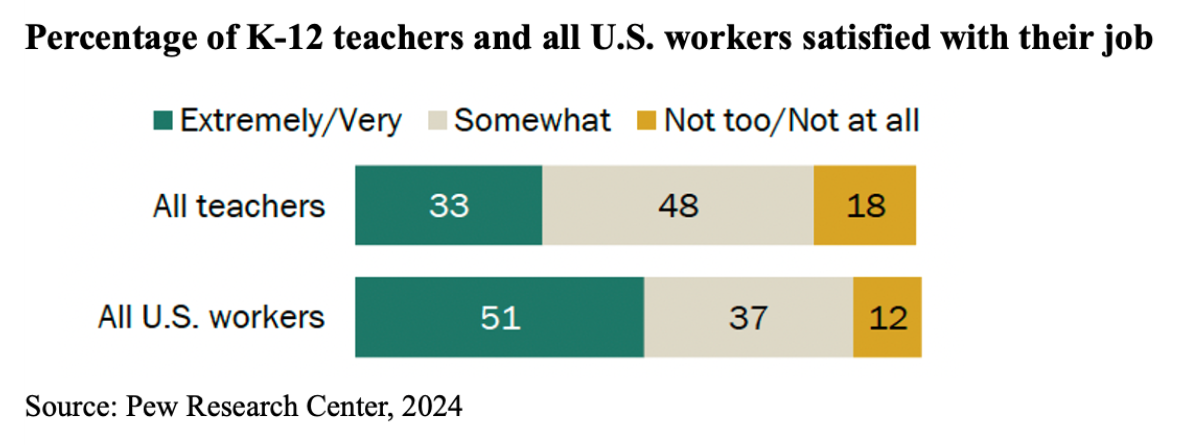
Complaints from teachers about low salaries, excessive administrative requirements, heavy workloads, lack of autonomy, and excessive testing and accountability are not new. In a 2023 survey, only one-third of teachers reported being extremely or very satisfied with their jobs. About half said they were somewhat satisfied, while 18% said they were not satisfied (Pew Research Center, 2024). Compared to other U.S. workers, teachers are significantly less satisfied with their jobs.
The chart below shows the gap between how K–12 teachers and all U.S. workers describe their job satisfaction. It is an important reminder that the people we trust with our children’s learning are reporting lower levels of satisfaction than workers across many other fields.
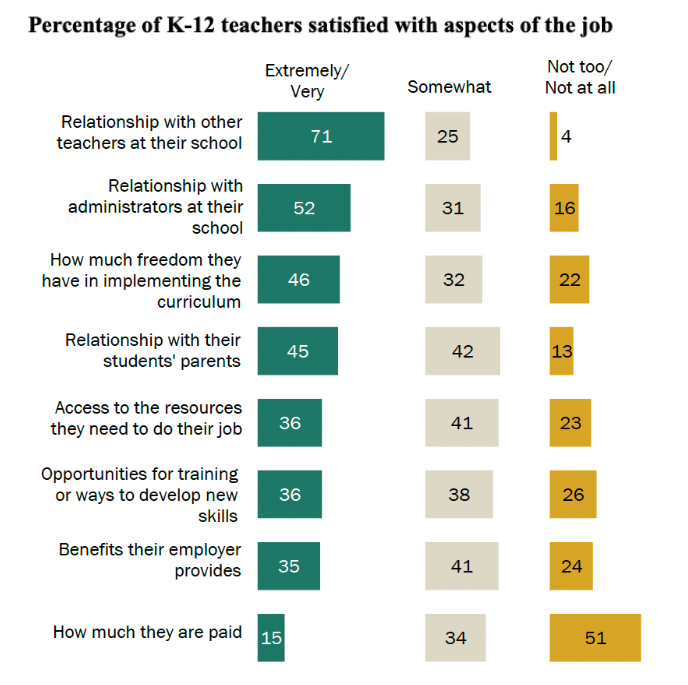
The declining interest in the teaching profession began before the COVID-19 pandemic, but the trend has grown more acute since 2020 (Schmitt & DeCourcy, 2022). Still, teacher dissatisfaction is not a simple story. Many teachers remain deeply connected to their colleagues and committed to their students. For example, while most teachers reported being highly satisfied with their relationships with other teachers in their school, fewer reported being highly satisfied with their relationships with school administrators.
That difference matters. Teachers need collegial support, but they also need leadership that listens, protects planning time, reduces unnecessary burdens, supports instructional expertise, and creates the conditions for excellent teaching.
The next chart provides a more detailed look at the aspects of the job with which teachers are more – and less – satisfied.
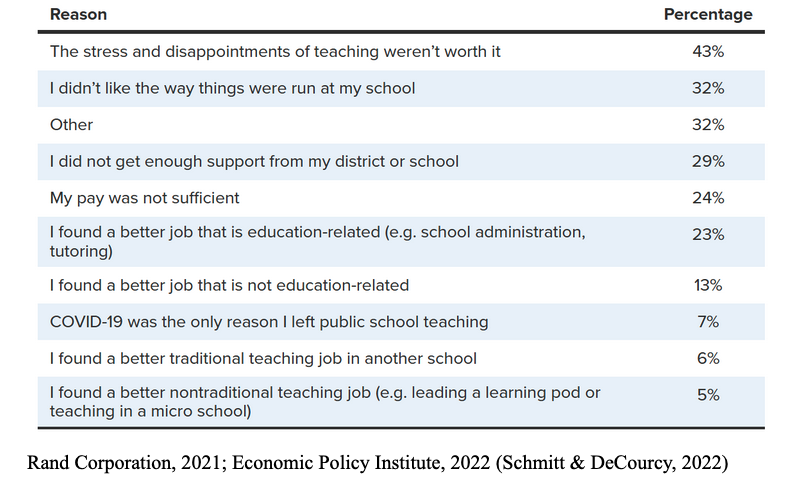
In regard to teachers who leave their teaching positions, RAND researchers Diliberti, Schwartz, and Grant (2021) concluded that stress is at the heart of many teachers’ decisions to leave the profession early, both before and during the pandemic. In their survey of nearly 1,000 former public school teachers, four in ten voluntary early leavers said “the stress and disappointments of teaching weren’t worth it” as a reason for leaving.
Stress is particularly acute for teachers of color and contributes to their higher attrition rates (García & Weiss, 2019; Cormier et al., 2021; Steiner et al., 2022). This should concern all of us. Teachers of color are essential to the success of all students, and especially to students of color who benefit from seeing educators who reflect their identities and experiences. When teachers of color leave the profession at higher rates, students lose role models, schools lose expertise, and communities lose trusted leaders.
However, stress is not the only reason teachers leave. As the chart below shows, teachers cite a range of reasons for leaving the profession, including compensation, working conditions, lack of support, and broader dissatisfaction with the demands of the job.
Percentage of teachers citing each reason for leaving teaching
There is no single reason teachers become dissatisfied, and there is no single reason they leave. But if we are serious about recruiting and retaining highly effective teachers, we must move beyond once-a-year appreciation. We must build systems that show appreciation through action.
Research points to several clear strategies. Linda Darling-Hammond and colleagues have emphasized the importance of investing in high-quality, accessible, financially supported pathways into teaching. Teachers who receive affordable, comprehensive preparation, including through strong teacher residencies, tend to stay in teaching longer and become more effective.
Beginning teachers also need mentoring and induction support so they are not left to sink or swim during their earliest years in the classroom. New teachers who are mentored and well supported become effective sooner and stay in teaching longer than those who lack mentoring and support.
Competitive compensation and improved working conditions are also essential. Turnover is one of the key drivers of teacher shortages because many open positions are created when teachers leave the profession before retirement. Increasing teacher compensation and improving working conditions can positively affect recruitment and retention.
Finally, stronger data systems are needed so policymakers and communities can better understand teacher shortages and design informed solutions. Access to consistent, accurate, transparent, timely, and regularly updated data enables education leaders and stakeholders to identify where shortages are most severe and how those shortages affect students differently across schools and communities (Darling-Hammond et al., 2016; 2023).
As a former teacher, I know how meaningful appreciation can be. A handwritten note from a student can stay with you for years. A parent’s thank-you can lift your spirit. A principal’s public recognition can affirm that your work is seen. And as a former superintendent, I also know that appreciation cannot stop there.
Appreciation must show up in the budget.
It must show up in salaries.
It must show up in class sizes, planning time, professional learning, leadership pathways, and safe, supportive working environments.
It must show up in how we treat teachers as professionals with expertise, not simply as implementers of decisions made far away from the classroom.
Research shows that the most critical school-based factor in student achievement is high-quality educators. Every day, teachers provide students with guidance, motivation, and inspiration so they can succeed far beyond the boundaries of their school building. But teaching is difficult and stressful work. In a national survey, about half of teachers said that if there is one thing they want the public to know, it is that teaching is a difficult job and that teachers are hardworking (Pew Research Center, 2024a).
We should listen.
Sources of teacher stress include long hours during the school year, large class sizes, second jobs to supplement pay, evaluation processes that rely heavily on standardized test scores, discrimination against teachers of color, lack of control over curriculum, and an increasingly politicized environment (Schmitt & DeCourcy, 2022). More comprehensive preparation, stronger collaboration between teachers and administrators, and better mentoring for new teachers would all be positive steps. But without major gains in compensation and working conditions, too many talented people will continue to see teaching as unsustainable.
According to the NEA, the average starting salary for teachers is $45,526. In some states, including Missouri, Montana, and Nebraska, average starting salaries are under $40,000 (NEA, 2025). Under the Blueprint for Maryland’s Future, Maryland school districts are required to raise the minimum starting teacher salary to $60,000 by July 1, 2026. While this is the mandated target, as of March 2026, it comes as no surprise that many districts are still transitioning, with some still below this threshold whereas others have met it. In the end, we cannot keep saying teachers are among the most important people in society while paying many of them wages that require second jobs or make it difficult to remain in the profession.
Of course, significant salary increases would be costly. Appropriate class sizes, additional planning time, reduced non-teaching duties, and stronger mentoring systems also require resources. Many community and educational leaders may call these ideas aspirational. But if we want every child to have access to a highly qualified teacher, we must begin thinking differently about what is possible.
Teacher Appreciation Week gives us a moment to say thank you. However, the real measure of our appreciation is what we do after the week ends.
As NCEED continues its work to eliminate educational disparities, we will keep lifting up the central role of teachers in equity, opportunity, and student success. We will continue to ask hard questions about who has access to experienced and certified teachers, where shortages are most severe, and what policies and practices can help build a stronger and more stable teacher workforce.
This month’s Numbers That Matter article will examine the demographics and other key variables shaping today’s teacher corps. These data are important because behind every number is a classroom, a teacher, and a group of students whose futures are being shaped every day. Further, Dr. Sharde Theodore, Assistant Professor at Morgan State University and research faculty in the Teachers and School Leaders pillar for NCEED explores why representation matters through the power and impact of Black educators.
This May, I hope we all take time to thank a teacher. But I also hope we commit to something deeper: building the kind of schools and systems where teachers feel respected, supported, fairly compensated, and able to do the work they came to do.
Because when we take care of teachers, we take care of children.
And when we invest in teachers, we invest in the future of every community.
-Meria J. Carstarphen
———————————————
References:
Bruno, M., 2024. K-12 Teachers Are Not A Happy Lot. https://www.forbes.com/sites/brunomanno/2024/06/11/k-12-teachers-are-not-a-happy-lot/
Cardichon, J., Darling-Hammond, L., Yang, M., Scott, C., Shields, P. M., & Burns, D. (2020). Inequitable opportunity to learn: Student access to certified and experienced teachers. Palo Alto, CA: Learning Policy Institute.
Cormier, C., Wong, V., McGrew, J., Ruble, L., and Worrell, F., 2021. Stress, Burnout, and Mental Health Among Teachers of Color.”Learning Professional 42, no. 1: 54–57.
Darling-Hammond, L., Sutcher, L., & Carver-Thomas, D. (2016). Solving the Teacher Shortage: How to Attract and Retain Excellent Educators. Palo Alto, CA: Learning Policy Institute.
Darling-Hammond, L., DiNapoli, M., Jr., & Kini, T. (2023). The federal role in ending teacher shortages. Learning Policy Institute. https://doi.org/10.54300/649.892
Doan, S., Steiner, E., & Pandey, R. Teacher Well-Being and Intentions to Leave in 2024 (RAND).
https://www.rand.org/content/dam/rand/pubs/research_reports/RRA1100/RRA1108-12/RAND_RRA1108-12.pdf
Economic Policy Institute, 2022
https://www.epi.org/publication/shortage-of-teachers/?utm_source=chatgpt.com
Forbes (Green, P.) 2024. The State Of The Teaching Profession. Forbes.com. https://www.forbes.com/sites/petergreene/2024/04/05/the-state-of-the-teaching-profession/
Gallup, 2022. U.S. Workers’ Burnout Rates by Industry. https://news.gallup.com/poll/393500/workers-highest-burnout-rate.
García, Emma, and Elaine Weiss. 2019a. The Teacher Shortage Is Real, Large and Growing, and Worse Than We Thought: The First Report in “The Perfect Storm in the Teacher Labor Market” Series. Economic Policy Institute, March 2019.
García, E. & Weiss, E., 2019b. U.S. Schools Struggle to Hire and Retain Teachers: The Second Report in “The Perfect Storm in the Teacher Labor Market” Series. Economic Policy Institute.
García, Emma, and Elaine Weiss. 2019c. Low Relative Pay and High Incidence of Moonlighting Play a Role in the Teacher Shortage, Particularly in High-Poverty Schools: The Third Report in “The Perfect Storm in the Teacher Labor Market” Series. Economic Policy Institute, May 2019.
García, Emma, and Elaine Weiss. 2019d. Challenging Working Environments (“School Climates”), Especially in High-Poverty Schools, Play a Role in the Teacher Shortage: The Fourth Report in “The Perfect Storm in the Teacher Labor Market” Series. Economic Policy Institute, May 2019.
Learning Policy Institute. (2025). An Overview of Teacher Shortages: 2025 [Fact sheet].
NEA, 2025. Educator Pay Data. https://www.nea.org/resource-library/educator-pay-and-student-spending-how-does-your-state-rank
PDK Poll, 2022. PDK Poll of the Public’s Attitudes Toward the Public Schools.
https://pdkpoll.org/2022-pdk-poll-results/
Pew Research Center, 2024a. Katherine Schaeffer. Key facts about public school teachers in the U.S. Key facts about public school teachers in the US | Pew Research Center
Pew Research Center, 2024b. Lin, L., Parker, K., & Horowitz, J. M. (2024). 2023 Survey of US Teachers: Job Satisfaction and Outlook.
Pew Research Center, 2024c. What’s It Like To Be a Teacher in America Today? https://www.pewresearch.org/social-trends/2024/04/04/whats-it-like-to-be-a-teacher-in-america-today/
Pew Research Center, 2024. How K-12 public teachers manage their workload | Pew Research Center
RAND Corporation, 2021. Melissa Kay Diliberti, Heather L. Schwartz, and David Grant, “Stress Topped the Reasons Why Public School Teachers Quit, Even Before COVID-19,”
Schmitt, J., & DeCourcy, K. (2022). The Pandemic Has Exacerbated a Long-Standing National Shortage of Teachers. Economic Policy Institute. https://www.epi.org/publication/shortage-of-teachers/
Steiner, E. & Woo, A., 2021. Job-Related Stress Threatens the Teacher Supply: Key Findings from the 2021 State of the U.S. Teacher Survey. RAND Corporation.
We Are Teachers, 2019. 12 Powerful Statistics: That Prove Why Teachers Matter. https://www.weareteachers.com/teacher-impact-statistics/. (Sources: ING Foundation Survey, National Center for Education Statistics, The Harris Poll, and EdWeek.)
YouGov, 2022. Dumitru, O. How are teachers changing their students’ lives? https://today.yougov.com/society/articles/43501-how-teachers-changing-their-students-lives-poll