

Teacher Appreciation Week is May 4-8, 2026, and National Teacher Appreciation Day is May 5, 2026. The May Director’s Desk article, Teacher Appreciation and Shortages, examines teachers’ satisfaction and strategies to address teacher shortages, stress, and burnout. As the Director notes, data suggest that once-a-year expressions of appreciation – flowers, cards, lunches, and gifts – may not be enough as the national teacher shortages grow each year. This article examines the characteristics of today’s U.S. teaching corps and teachers’ perceptions of the challenges they face in the classroom.
Today, nearly four million K-12 teachers serve more than 50 million students in 98,500 U.S. public schools. It is estimated that the average teacher affects over 3,000 students during their career, both in and out of their classroom (NCES, 2024).
According to the Bureau of Labor Statistics, the majority of teachers are in their 30s and 40s, and the large majority are women (see below).
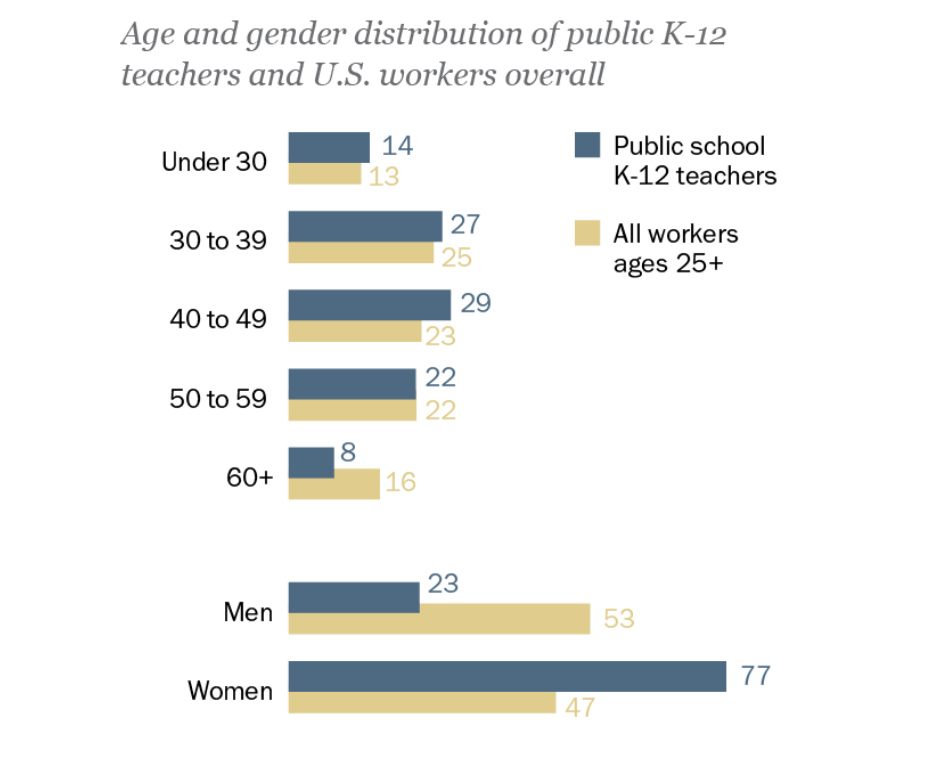
Source: Bureau of Labor Statistics; Pew Research Center, 2024a.
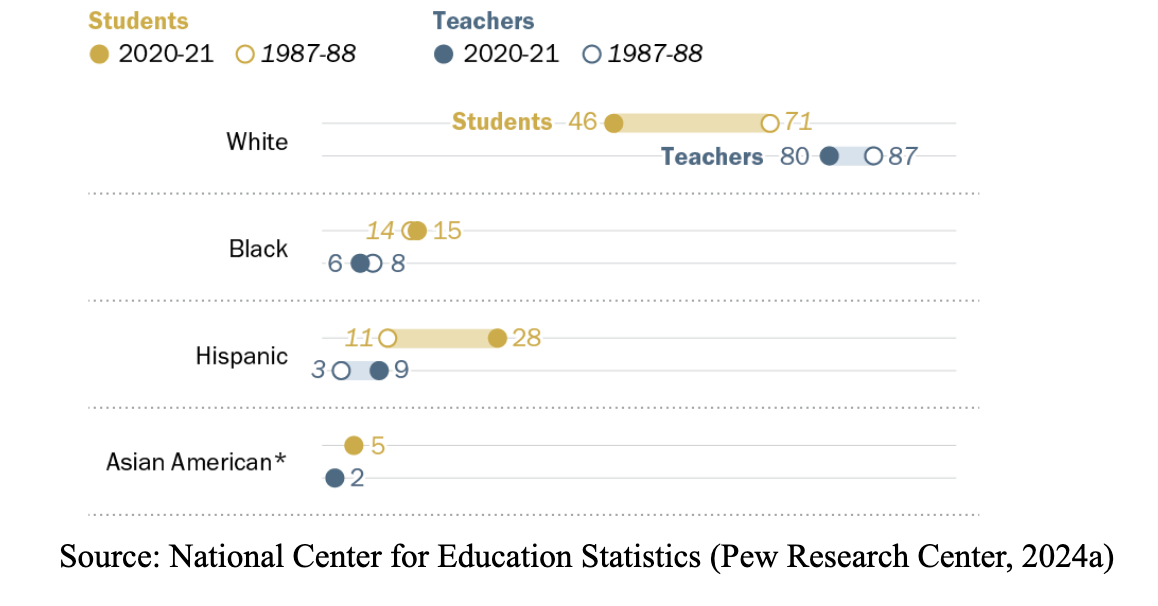
The graph below compares the racial and ethnic makeup of U.S. public school teachers and students and how they have changed over time. While the percentage of white students declined dramatically from 71% in 1987-88 to 46% in 2020-21, the large majority of teachers are white (though the percentage decreased from 87% to 80% over this period). The second-largest change in the student population was among Hispanic students, which increased from 11% to 28%. The percentage of Hispanic teachers nationally also increased from 3% to 9%, while the percentage of Black teachers declined from 8% to 6%.
% of public school K-12 teachers and students who are_______, by year
As discussed in the Director’s Desk article, research on teacher satisfaction, stress, and burnout paints a discouraging view of the current state of the teaching profession.
- In a 2023 survey, only a third of teachers reported being extremely or very satisfied with their jobs overall. About half (48%) said they’re somewhat satisfied, while 18% said they are “not too or not at all” satisfied with their job (Pew Research Center, 2024).
- A 2022 Gallup survey of U.S. workers revealed that workers in K-12 education reported significantly higher burnout rates than those in any other industry. 44% of teachers reported being “always” or “very often” burned out at work.
- RAND researchers Diliberti, Schwartz, and Grant (2021) concluded that stress was the #1 reason teachers leave the profession early (both before and during the pandemic).
In an Economic Policy Institute study (Schmitt & DeCourcy, 2022), the top four reasons former teachers cited for leaving the profession were:
- The stress and disappointment of teaching weren’t worth it (43%
- I didn’t like the way things were run at my school (32%)
- I did not get enough support from my school or school (29%)
- My pay was not sufficient (24%).
Clearly, salaries have long been a concern and challenge, with many districts struggling to compete with other professions and, often, even neighboring school districts.
According to the NEA (2025), the average starting salary for teachers is $45,526. In some states, such as Missouri, Montana, and Nebraska, the average starting salaries are under $40,000. According to the NEA study:
- 87% of pre-K–12 teachers said that low pay is a moderate or serious concern;
- 40% reported holding more than one job;
- 95% said they spend their own money to meet the needs of their students; and
- 37% reported having a moderate or serious problem making a living wage.
However, compensation is just one issue. To address teacher burnout, dissatisfaction, and turnover, it would be helpful to better understand what other factors are driving teachers to leave the profession. What are the causes of stress and disappointment? What aspects of how their schools are run are most frustrating? And, what support(s) do teachers really want and need? The answers to these questions may not be as simple as many school leaders and leading experts assume (see Darling-Hammond et al., 2016; 2023). In this article, we will look more closely at some of these issues.
The 2023 Pew Research Center Survey of U.S. Teachers provides a detailed, less-than-optimistic view of teachers’ perceptions of student achievement, motivation, behavior, and mental health, as well as parental involvement and accountability (Lin et al., 2024). Surveys by the NCES and RAND have reported similar findings (Doan, Steiner, & Pandey, 2024).
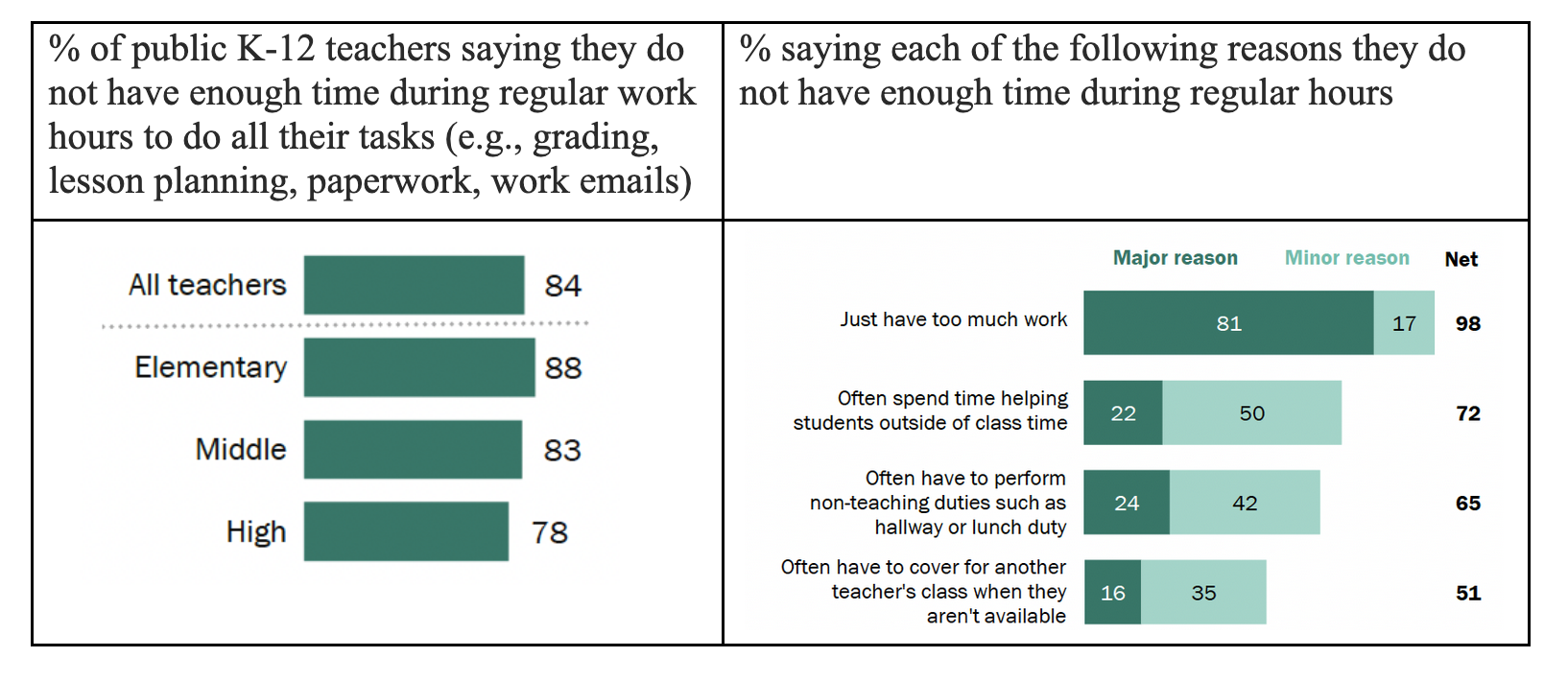
Workload
- 84% of teachers said there’s not enough time in the day to get all their work done
- 81% of the teachers who said they don’t have enough time cited “just having
Academics
- 48% of the teachers said the academic performance of most students at their school is fair or poor; 33% said it’s good, and only 17% said it’s excellent or very good.
- At high-poverty schools, 73% of the teachers said the academic performance of most students at their school is fair or poor (see below).
% of public K-12 teachers saying the academic performance of most students at their school is…

Classroom Issues & Distractions
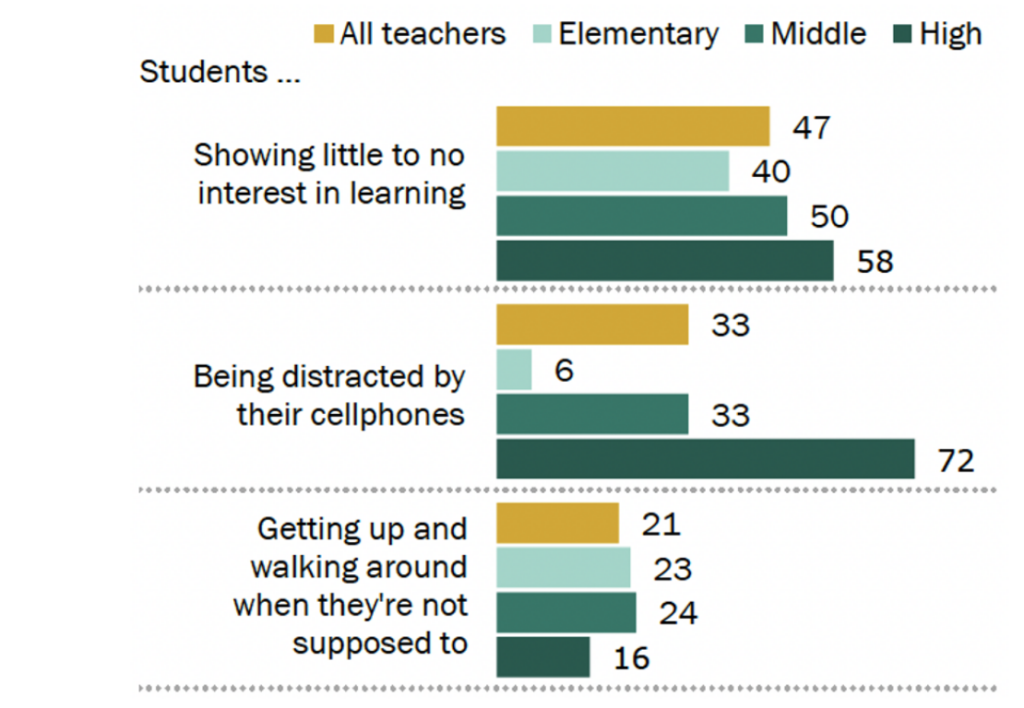
- 47% of teachers said students showing little or no interest in learning is a major problem in their classroom; 58% among high school teachers.
- One in five (21%) teachers said that students getting up and walking around when they’re not supposed to is a major problem.
- Nearly three-fourths (72%) of high school teachers said that students being distracted by their cellphones is a major problem.
% of public K-12 teachers saying the following are major problems in their classroom
Behavior and Mental Health
- 49% of all teachers said students’ behavior at their school is fair or poor; 35% said it’s good, and 13% rate it as excellent or very good.
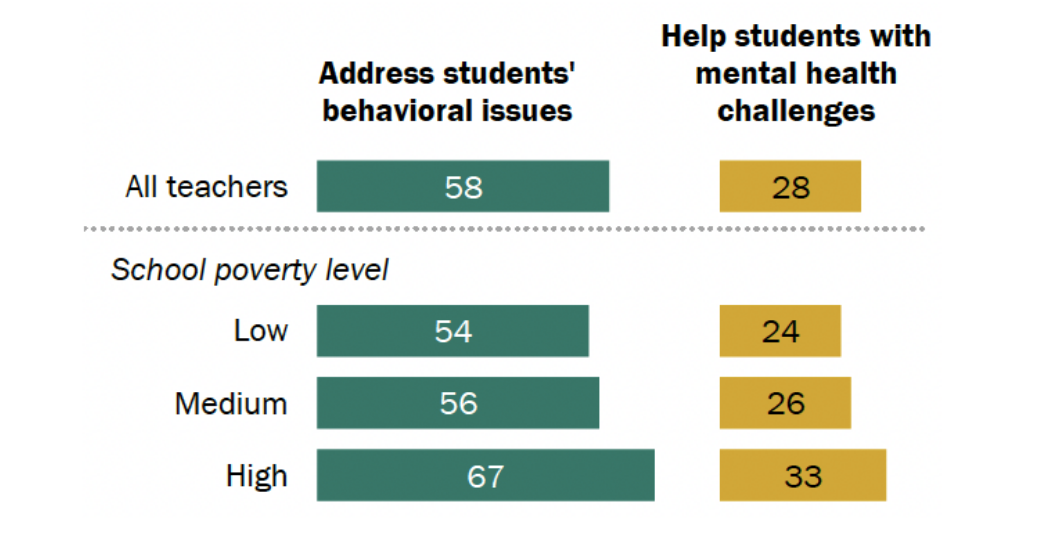
- At high-poverty schools, 67% of teachers reported having to address students’ behavioral issues daily, compared with 54% of teachers at low-poverty schools.
- 28% of all teachers said they have to help students with mental health challenges daily.
% of public K-12 teachers saying the behavior of most students at their school is…

% of public K-12 teachers saying they have to do the following at work every day:
Verbal Abuse and Violent Behavior
- The majority of teachers (68%) said they have experienced verbal abuse from their students, such as being yelled at or verbally threatened. 21% said they experience verbal abuse at least a few times a month.
- Physical violence is far less common, but 9% of teachers said a student is physically violent toward them at least a few times a month. An additional 31% said students have been physically violent toward them, but less often than a few times a month.
- Elementary teachers were more likely than middle or high school teachers to say they experience verbal abuse or physical violence from students at least a few times a month.
- Teachers who are women were more likely than male teachers to say a student had been physically violent toward them (44% versus 30%, respectively).
% of public K-12 teachers saying they experienced each of the following from a student:

Influence Over Discipline and Discipline Practices
- Two-thirds (67%) of teachers said they don’t have enough influence over discipline practices at their school
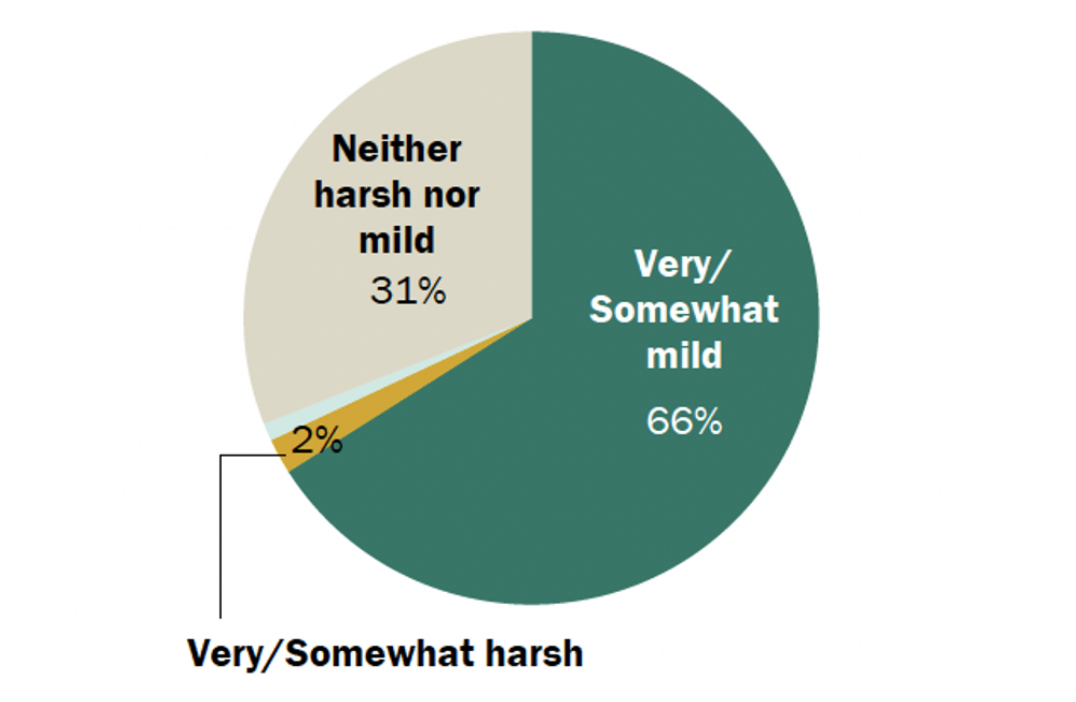
- 66% of teachers said that the current discipline practices at their school are very or somewhat mild.
- 2% said the discipline practices at their school are very or somewhat harsh.
% of public K-12 teachers saying each of the following has_____ influence when it comes to determining discipline practices at their school

% of public K-12 teachers saying that the current discipline practices at their school are…
Parent Accountability
- Most teachers said parents do too little when it comes to: Holding their children accountable (79%); Helping their children with their schoolwork (68%); and Ensuring their children’s attendance in school (63%).
- Differences by school poverty level are particularly large when it comes to parents helping their children with schoolwork and ensuring their attendance.
% of public K-12 teachers saying their students’ parents do too little when it comes to the following:
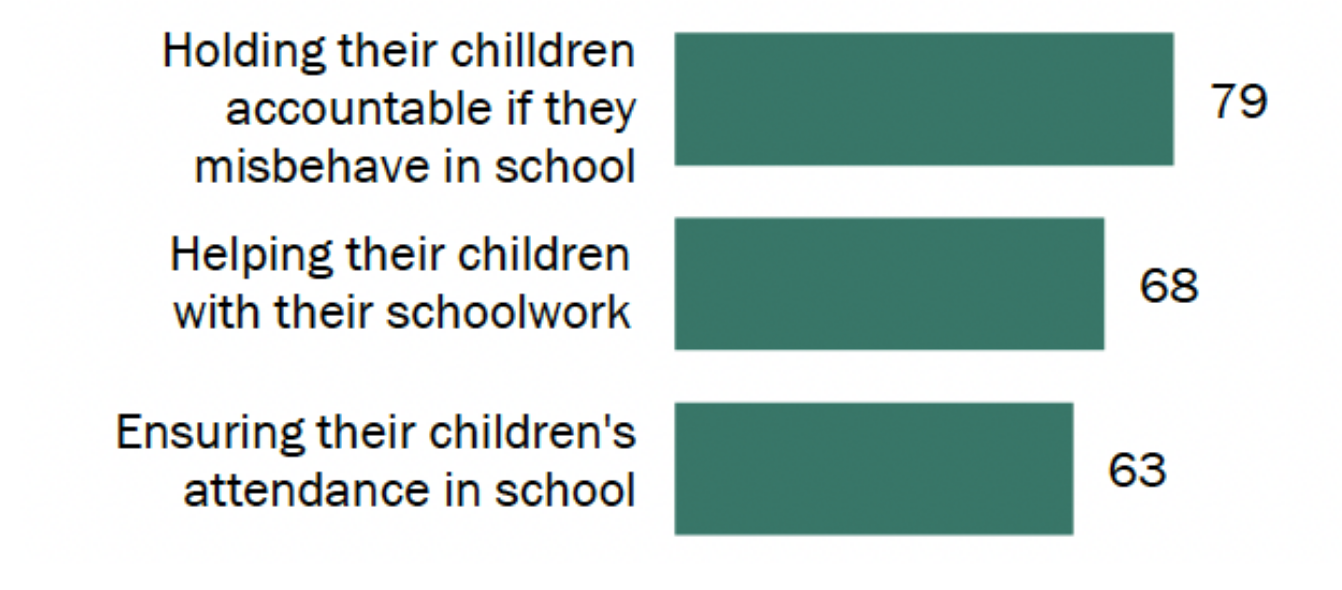
% of public K-12 teachers saying their students’ parents do too little when it comes to the following:

Source: Pew Research Center, 2024b. Lin, L., Parker, K., & Horowitz, J. M. (2024). 2023 Survey of US Teachers: Job Satisfaction and Outlook.
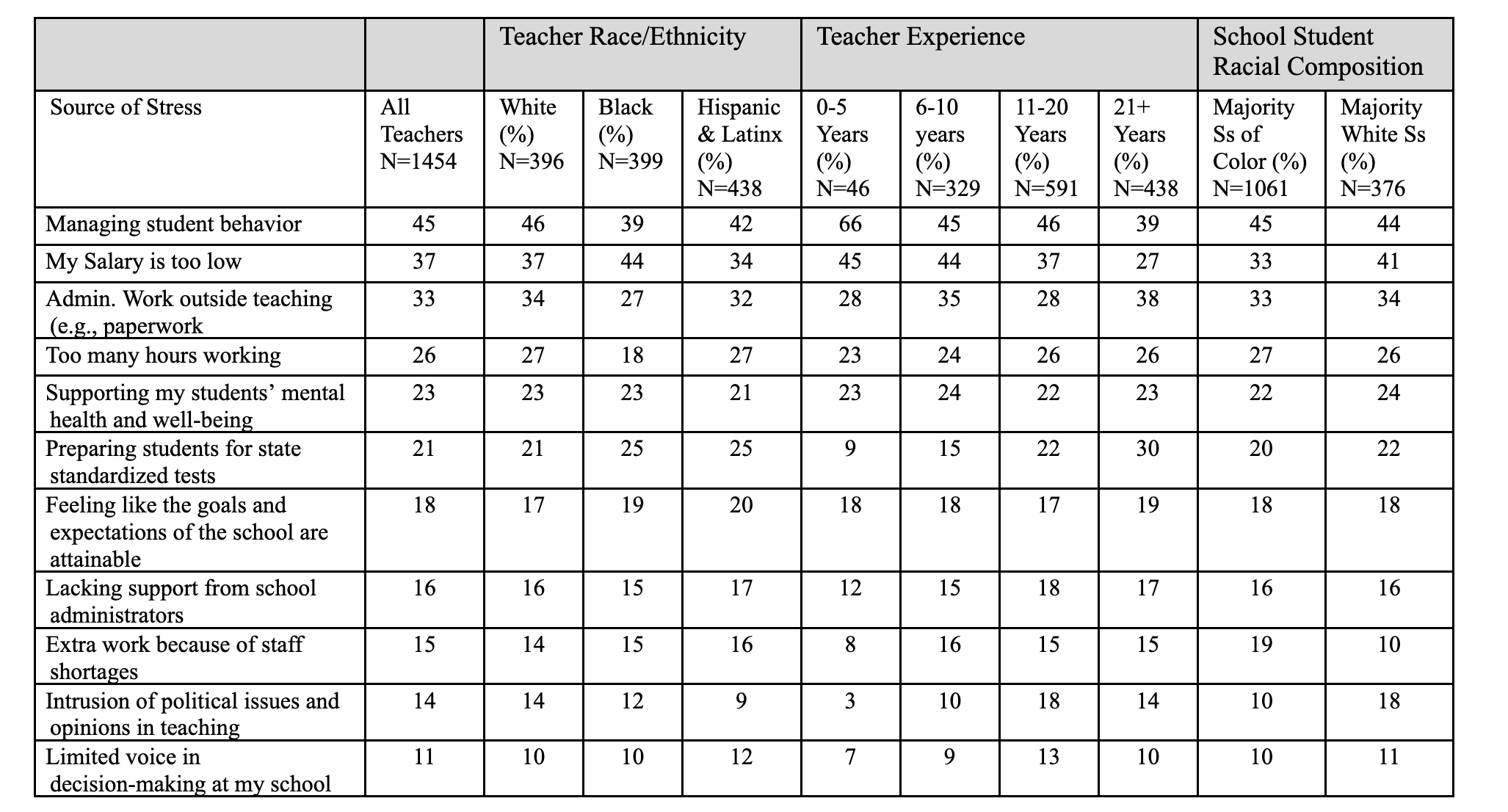
The table below from the RAND study concerning teacher stress provides a useful summary of many of the key issues raised by teachers in the Pew Research Center survey and other teacher surveys concerning teacher satisfaction, stress, and burnout. The teachers in the sample were drawn from RAND’s American Teacher Panel, which includes more than 25,000 teachers nationwide, using probability-based methods.
Teachers’ Top-Ranked Sources of Job-Related Stress, by Race/Ethnicity, Experience, and School Student Racial Composition*
Source: Doan, Steiner, and Pandey, 2024. Teacher Well-Being and Intentions to Leave in 2024: 2024 State of the American Teacher Survey. RAND Corporation. https://www.rand.org/pubs/research_reports/RRA1108-12.html.
As in many other studies, low salaries are among the most frequently cited concerns among teachers in the RAND study. Too much work, lack of planning time, testing, and having to devote too much time to administrative and non-teaching duties are also frequent complaints. A more general concern raised by teachers and former teachers is the lack of support they receive from the school and/or district administration. What exactly “lack of support” means is a critical question. What kinds of support would have a significant impact on teachers’ attitudes toward their jobs and, perhaps, increase recruitment and retention of young teachers?
Teacher responses to the RAND and Pew Research Center surveys suggest that a lack of support in the areas of discipline, mental health, and accountability are major concerns. In fact, in the RAND study, “Managing student behavior” was the most frequently cited “source of job-related stress.” That was particularly true for teachers with the least experience (i.e., 0-5 years), among whom that issue was cited by 66% of the respondents (see above).
While there are many causes of teacher dissatisfaction, stress, and burnout, the issues and solutions are not simple. It is essential that school leaders understand that, for many teachers, critical issues are even more fundamental than the fact that teaching is incredibly hard work, or that training is inadequate, or that teachers are dramatically underpaid.
—————————————-
References:
Bruno, M., 2024. K-12 Teachers Are Not A Happy Lot. https://www.forbes.com/sites/brunomanno/2024/06/11/k-12-teachers-are-not-a-happy-lot/
Cardichon, J., Darling-Hammond, L., Yang, M., Scott, C., Shields, P. M., & Burns, D. (2020). Inequitable opportunity to learn: Student access to certified and experienced teachers. Palo Alto, CA: Learning Policy Institute.
Cormier, C., Wong, V., McGrew, J., Ruble, L., and Worrell, F., 2021. Stress, Burnout, and Mental Health Among Teachers of Color.”Learning Professional 42, no. 1: 54–57.
Darling-Hammond, L., Sutcher, L., & Carver-Thomas, D. (2016). Solving the Teacher Shortage: How to Attract and Retain Excellent Educators. Palo Alto, CA: Learning Policy Institute.
Darling-Hammond, L., DiNapoli, M., Jr., & Kini, T. 2023. The federal role in ending teacher shortages. Learning Policy Institute. https://doi.org/10.54300/649.892
Doan, S., Steiner, E., & Pandey, R., 2024. Teacher well-being and intentions to leave in 2024: Findings from the 2024 State of the American Teacher Survey. RAND Corporation. https://www.rand.org/content/dam/rand/pubs/research_reports/RRA1100/RRA1108-12/RAND_RRA1108-12.pdf; https://www.rand.org/pubs/research_reports/RRA1108-12.html.
Economic Policy Institute, 2022
https://www.epi.org/publication/shortage-of-teachers/?utm_source=chatgpt.com
Forbes (Green, P.) 2024. The State Of The Teaching Profession. Forbes.com. https://www.forbes.com/sites/petergreene/2024/04/05/the-state-of-the-teaching-profession/
Gallup, 2022. U.S. Workers’ Burnout Rates by Industry. https://news.gallup.com/poll/393500/workers-highest-burnout-rate.
García, Emma, and Elaine Weiss. 2019a. The Teacher Shortage Is Real, Large and Growing, and Worse Than We Thought: The First Report in “The Perfect Storm in the Teacher Labor Market” Series. Economic Policy Institute, March 2019.
García, E. & Weiss, E., 2019b. U.S. Schools Struggle to Hire and Retain Teachers: The Second Report in “The Perfect Storm in the Teacher Labor Market” Series. Economic Policy Institute.
García, Emma, and Elaine Weiss. 2019c. Low Relative Pay and High Incidence of Moonlighting Play a Role in the Teacher Shortage, Particularly in High-Poverty Schools: The Third Report in “The Perfect Storm in the Teacher Labor Market” Series. Economic Policy Institute, May 2019.
García, Emma, and Elaine Weiss. 2019d. Challenging Working Environments (“School Climates”), Especially in High-Poverty Schools, Play a Role in the Teacher Shortage: The Fourth Report in “The Perfect Storm in the Teacher Labor Market” Series. Economic Policy Institute, May 2019.
Learning Policy Institute. (2025). An Overview of Teacher Shortages: 2025 [Fact sheet].
Lin, L., Parker, K., & Horowitz, J. M. (2024). 2023 Survey of US Teachers: Job Satisfaction and Outlook, Pew Research Center.
NCES, 2024. National Center for Education Statistics. (2024). Digest of Education Statistics 2023 (NCES 2024-009). U.S. Department of Education. https://nces.ed.gov/programs/digest/
NEA, 2025. Educator Pay Data. https://www.nea.org/resource-library/educator-pay-and-student-spending-how-does-your-state-rank
PDK Poll, 2022. PDK Poll of the Public’s Attitudes Toward the Public Schools.
https://pdkpoll.org/2022-pdk-poll-results/
Pew Research Center, 2024a. Katherine Schaeffer. Key facts about public school teachers in the U.S. Key facts about public school teachers in the US | Pew Research Center
Pew Research Center, 2024b. Lin, L., Parker, K., & Horowitz, J. M. (2024). 2023 Survey of US Teachers: Job Satisfaction and Outlook.
Pew Research Center, 2024c. What’s It Like To Be a Teacher in America Today? https://www.pewresearch.org/social-trends/2024/04/04/whats-it-like-to-be-a-teacher-in-america-today/
Pew Research Center, 2024. How K-12 public teachers manage their workload | Pew Research Center
RAND Corporation, 2021. Melissa Kay Diliberti, Heather L. Schwartz, and David Grant, “Stress Topped the Reasons Why Public School Teachers Quit, Even Before COVID-19,”
Schmitt, J., & DeCourcy, K. (2022). The Pandemic Has Exacerbated a Long-Standing National Shortage of Teachers. Economic Policy Institute. https://www.epi.org/publication/shortage-of-teachers/
Steiner, E. & Woo, A., 2021. Job-Related Stress Threatens the Teacher Supply: Key Findings from the 2021 State of the U.S. Teacher Survey. RAND Corporation.
We Are Teachers, 2019. 12 Powerful Statistics: That Prove Why Teachers Matter. https://www.weareteachers.com/teacher-impact-statistics/. (Sources: ING Foundation Survey, National Center for Education Statistics, The Harris Poll, and EdWeek.)
YouGov, 2022. Dumitru, O. How are teachers changing their students’ lives? https://today.yougov.com/society/articles/43501-how-teachers-changing-their-students-lives-poll