
Some commitments are not just professional. They are deeply personal. My commitment to inclusion began long before I became a superintendent, researcher, or director. It began as a child, watching my cousin with Down syndrome move through school in ways that made clear he was too often treated as separate rather than as fully belonging. In our family, he was simply one of us playing games, attending birthday parties, and going to church. In school, that was not always the message he received. For example, all of his teachers and classes were in outside portables separate from the school which was the main building. I really only saw him with our family even though we were attending the same school every day. Those early experiences stayed with me and helped shape the educator I would become. Years later, when I was honored by the National Down Syndrome Congress, I saw that recognition not simply as a professional achievement, but as an affirmation of a lifelong belief that every child deserves dignity, access, support, and genuine inclusion.
I have often written and spoken about the amazing work our public schools do every day. In the February edition, we focused on the Whole Child, the many curricular and co-curricular programs, and the range of mental and physical health wraparound services that schools provide to children and families. As I wrote, schools “do not get to choose which issues they get to address and which are someone else’s responsibility.”
Nowhere is that statement more evident than in special education. April is Autism Awareness Month, and today, more than 1 million students ages 3 to 21 are identified with autism spectrum disorder (ASD) and receive special education services under the U.S. Individuals with Disabilities Education Act (IDEA). Yet autism is just one of 13 disability categories recognized by IDEA under which a student may qualify for services.
IDEA disability categories include:
Autism – A developmental disability significantly affecting verbal and nonverbal communication and social interaction, generally evident before age three, that adversely affects a child’s educational performance. Other characteristics often associated with autism include engaging in repetitive activities and stereotyped movements, resistance to environmental change or changes in daily routines, and unusual responses to sensory experiences.
Deaf-blindness – Concomitant hearing and visual impairments, the combination of which causes such severe communication and other developmental and educational needs that they cannot be accommodated in special education programs solely for children with deafness or children with blindness.
Deafness – A hearing impairment that is so severe that the child is impaired in processing linguistic information through hearing, with or without amplification, and that adversely affects a child’s educational performance.
Emotional Disturbance (ED) – Includes an inability to build or maintain satisfactory interpersonal relationships with peers and teachers, and inappropriate types of behavior or feelings under normal circumstances.
Hearing Impairment – An impairment in hearing, whether permanent or fluctuating, that adversely affects a child’s educational performance but is not included under the definition of deafness.
Intellectual Disability – Significantly subaverage general intellectual functioning, existing concurrently with deficits in adaptive behavior and manifested during the developmental period, that adversely affects a child’s educational performance.
Multiple Disabilities – Concomitant impairments, such as intellectual disability-blindness or intellectual disability-orthopedic impairment, the combination of which causes such severe educational needs that they cannot be accommodated in special education programs solely for one of the impairments.
Other Health Impairment (OHI) – Limited strength, vitality, or alertness due to health conditions, commonly including ADHD, resulting from chronic or acute health problems such as asthma, attention deficit disorder or attention deficit hyperactivity disorder, diabetes, epilepsy, a heart condition, hemophilia, lead poisoning, leukemia, nephritis, rheumatic fever, sickle cell anemia, and Tourette syndrome.
Orthopedic Impairment – A severe orthopedic impairment that adversely affects a child’s educational performance. This includes impairments caused by a congenital anomaly, impairments caused by disease such as poliomyelitis or bone tuberculosis, and impairments from other causes such as cerebral palsy, amputations, and fractures or burns that cause contractures.
Specific Learning Disability (SLD) – A disorder in one or more of the basic psychological processes involved in understanding or in using language, spoken or written, that may manifest in an imperfect ability to listen, think, speak, read, write, spell, or do mathematical calculations, including conditions such as perceptual disabilities, brain injury, minimal brain dysfunction, dyslexia, and developmental aphasia.
Speech or Language Impairment – A communication disorder, such as stuttering, impaired articulation, a language impairment, or a voice impairment, that adversely affects a child’s educational performance.
Traumatic Brain Injury (TBI) – An acquired injury to the brain caused by an external physical force, resulting in total or partial functional disability or psychosocial impairment, or both, that adversely affects a child’s educational performance.
Visual Impairment (including blindness) – An impairment in vision that, even with correction, adversely affects a child’s educational performance. The term includes both partial sight and blindness (IDEA, n.d.).
The most frequently served disabilities are shown in the figure below (Brusca-Vega, 2024).
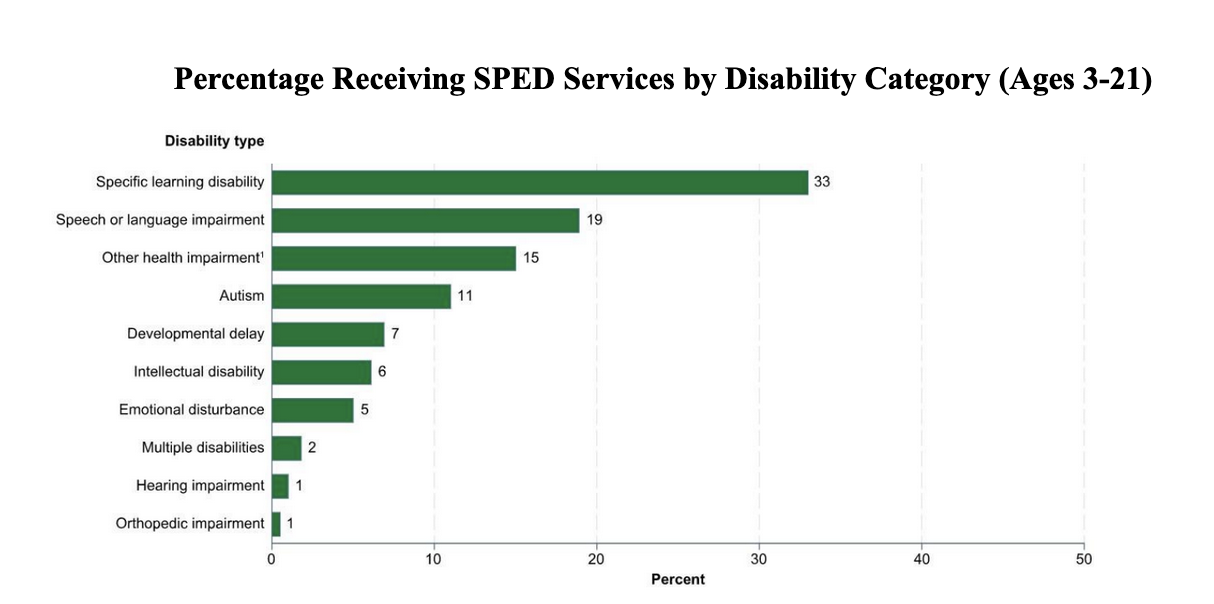
Source: National Center for Education Statistics (2022)
According to the National Center for Education Statistics (2024a), in 2022-23, 7.5 million students ages 3 to 21 received special education and/or related services, or about 15% of public school students. This reflects a sizable increase over the last decade. In 2012-13, about 6.4 million public school students received SPED or 504 services, or about 13%.
The statewide percentages of students receiving SPED services range from 13% to 22%. The State of Maryland has one of the lowest percentages at 13%.
Learning to teach is complex and demanding. While all teachers must learn to respond to their students’ needs, special education teachers face the additional challenge of working with students who often have the most significant learning and behavioral difficulties. SPED students may experience challenges related to attention, memory, reasoning, communication, physical functioning, and behavior. Some students have physical and/or cognitive challenges that require extensive support throughout much of the school day (McLeskey, 2017).
To keep pace with the increased demand for services, the number of SPED teachers has risen from approximately 470,000 in 2012-13 to 510,000 in 2022-23, an increase of about 9%. During this same period, the number of paraprofessionals increased from approximately 350,000 in 2012-13 to 420,000 in 2022-23, an increase of about 20% (NCES, 2024b).
However, a nationwide 2022 survey of schools found that vacancies in special education were nearly double those in other subject areas. The survey also found that 65% of public schools in the United States reported being understaffed in special education (Bodenhamer, 2023). Research has shown that large numbers of SPED teachers are simply leaving the field of special education (Billingsley & Bettini, 2019). Studies of burnout among special educators have identified a number of associated factors, including lack of administrative support and training, increased workloads, poor school working conditions, and the challenges of working with children, adolescents, and young adults with physical and/or cognitive impairments (Billingsley & Bettini, 2019; Mathews et al., 2021; Mason-Williams et al., 2020; Feng & Sass, 2013; Walker, 2017; Dewey et al., 2017).
Special educators and the families of children receiving special education services face complex challenges. Schools struggle to recruit and retain qualified special education teachers and related professionals, leading to high caseloads, teacher burnout, and reliance on paraprofessionals or contracted services. Students’ diverse and often complex disabilities, including autism, ADHD, speech or language impairments, and learning disabilities, require individualized support that can strain school and district resources. Families experience emotional and logistical burdens navigating assessments, individualized education plans (IEPs), and at times contentious interactions with schools, while debates over disability classifications and causes, such as those surrounding autism, add stress and uncertainty.
These issues are central to the work and research conducted by NCEED staff and faculty as we work with partners in Maryland and nationwide to address the most pressing issues facing students, parents, communities, teachers, and administrators. This month’s edition of the Equity Express includes an article by Dr. Elizabeth Morgan, Associate Professor in Morgan State University’s Department of Advanced Studies, Leadership, and Policy, and NCEED research faculty member, discussing her family’s personal journey with autism and the continued need to move from awareness to “acceptance with action.”
In addition, staff writer Bill Caritj’s April Numbers That Matter article will take a deeper dive into special education staffing needs and trends, including issues concerning teachers, paraprofessionals, speech-language pathologists, psychologists, and other related professionals.
When we talk about special education, we are talking about far more than compliance, staffing charts, or service models. We are talking about children and families who deserve to be seen, supported, and fully included in the life of their schools. We are also talking about educators and related service professionals whose work requires extraordinary skill, patience, and commitment, often under conditions of intense pressure. If we are serious about educational equity, then we must be serious about strengthening the systems that support students with disabilities and the professionals who serve them. That work is urgent, and it is personal for me. The lessons I learned early in life about inclusion, dignity, and belonging still shape how I see this work today.
==================================
References:
Billingsley, Bonnie, Anna-Maria Fall, and Thomas O. Williams. 2006. “Who is Teaching Students with Emotional Disorders? A Profile and Comparison to Other Special Educators,” Behavioral Disorders 31(1): 252–264.
Billingsley, B., & Bettini, E. (2019). Special education teacher attrition and retention: A review of the literature. Review of educational research, 89(5), 697-744.
Brusca-Vega, R. (2024). Understanding Disability Categories
Bureau of Labor Statistics, U.S. Department of Labor, Occupational Outlook Handbook, Special Education Teachers, https://www.bls.gov/ooh/education-training-and-library/special-education-teachers.htm (March 02, 2026).
CDC, 2025. Autism Partner Toolkit. Public Health, May 21, 2025 https://www.cdc.gov/autism/php/toolkit/index.html
Dewey, J., Sindelar, P., Bettini, E., Boe, E., Rosenberg, M., and Leko, C., 2017. Explaining the Decline in Special Education Teacher Employment from 2005 to 2012. Exceptional Children, v83 n3 p315-329
Feng, L., & Sass, T. R. (2013). What makes special-education teachers special? Teacher training and achievement of students with disabilities. Economics of Education Review, 36, 122-134.
Friend, M., & Bursuck, W. (2019). Including Students with Special Needs: A Practical Guide for Classroom Teachers (6th ed.). Pearson.
IDEA, n.d. IDEA Sec. 300.8 Child with a disability. https://sites.ed.gov/idea/regs/b/a/300.8.
Lipkin, P. & Okamoto, J., 2015. Council on Children with Disabilities and Council on School Health. The Individuals with Disabilities Education Act (IDEA) for children with special educational needs. Pediatrics, 136(6).
Lipscomb, S., Hamison, J., Liu Albert, Y., Burghardt, J., Johnson, D. R., & Thurlow, M. (2017). Preparing for Life after High School: The Characteristics and Experiences of Youth in Special Education. Findings from the National Longitudinal Transition Study 2012. Volume 2: Comparisons across Disability Groups. Full Report. NCEE 2017-4018. National Center for Education Evaluation and Regional Assistance.
Mason-Williams, L., Bettini, E., Peyton, D., Harvey, A., Rosenberg, M., & Sindelar, P. T. (2020). Rethinking shortages in special education: Making good on the promise of an equal opportunity for students with disabilities. Teacher Education and Special Education, 43(1), 45-62.
Mathews, H. M., Lillis, J. L., Bettini, E., Peyton, D. J., Pua, D., Oblath, R., … & Sutton, R. (2021). Working conditions and special educators’ reading instruction for students with emotional and behavioral disorders. Exceptional Children, 87(4), 476-496.
Mathews, H. M., Lillis, J. L., Bettini, E., Peyton, D. J., Pua, D., Oblath, R., … & Sutton, R. (2021). Working conditions and special educators’ reading instruction for students with emotional and behavioral disorders. Exceptional Children, 87(4), 476-496.
McLeskey, J., Council for Exceptional Children, & Collaboration for Effective Educator Development, Accountability and Reform. (2017). High-leverage practices in special education.
National Center for Education Statistics, 2024a. Students With Disabilities. Condition of Education. U.S. Department of Education, Institute of Education Sciences. Retrieved [date], from https://nces.ed.gov/programs/coe/indicator/cgg.
NCES, 2024b. National Center for Education Statistics (2024), IDEA Section 618 personnel data; Digest of Education Statistics 2023 tables on special education personnel.
NCES, 2024c. Most U.S. public elementary and secondary schools faced hiring challenges for the start of the 2024–25 academic year. https://ies.ed.gov/learn/press-release/most-u-s-public-elementary-and-secondary-schools-faced-hiring-challenges-start-2024-25-academic-year.
Walker, T., 2017. neaToday. Survey: Quality Professional Development Still Out of Reach for Teachers