


When I first became a teacher in my hometown of Selma, Alabama, I learned very quickly that education policy is never abstract. It shows up in the classroom. It shows up in whether or not children have access to strong early learning before they ever enter kindergarten. It shows up in whether or not teachers have the time, support, and compensation they need to stay in the profession. It shows up whether or not students are truly prepared for college, careers, and life after graduation.
As a former teacher, I know what it feels like to stand in front of students and want more for them than the system has made available. As a former superintendent, I know how difficult it is to move from big public commitments to daily implementation across schools, budgets, labor agreements, transportation systems, staffing models, and community expectations. And now, as I lead the National Center for the Elimination of Educational Disparities, I see the Blueprint for Maryland’s Future as one of the most important opportunities before us.
The Blueprint is not just a state reform plan. It is a statement of belief about what Maryland’s children deserve.
Passed by the Maryland General Assembly in 2021, the Blueprint for Maryland’s Future was designed to transform the state’s public education system into a world-class one. It calls for major investments in early childhood education, teacher compensation and preparation, college and career readiness, resources for students with greater needs, and stronger governance and accountability. At full implementation, the 10-year plan would increase annual education funding at the state and local levels by roughly $4 billion.
At NCEED, this work is especially meaningful because Dr. William “Brit” Kirwan, former Chancellor of the University System of Maryland, serves on our advisory board. Dr. Kirwan chaired the Commission on Innovation and Excellence in Education, the body whose work helped shape what is now known across Maryland as the Kirwan Plan. His leadership helped define the five major pillars of the Blueprint and continues to influence implementation through his role with the Accountability and Implementation Board. Having his wisdom connected to NCEED’s work is a tremendous asset as we consider how our research, faculty expertise, partnerships, and programs can support the promise of the Blueprint.
The question before us now is not whether the vision is worthy. It is.
The harder question is how Maryland moves from promise to practice.
The Blueprint is organized around five major pillars.
Pillar 1: Early Childhood Education
This pillar expands access to full-day prekindergarten at no or reduced cost for more families, strengthens public-private pre-K partnerships, expands wraparound services through Judy Centers and Patty Centers, increases funding for the Maryland Infants and Toddlers Program, and focuses on improving the quality of early childhood experiences.
As an educator, I have always believed that children do not begin learning on the first day of kindergarten. They arrive with years of experiences, strengths, needs, language, culture, and curiosity. Early childhood investments are among the clearest ways to reduce disparities before they widen.
Pillar 2: High Quality and Diverse Teachers and Leaders
This pillar seeks to elevate the teaching profession through a career ladder, competitive salaries, a $60,000 minimum teacher salary, incentives for National Board Certified teachers, stronger teacher preparation, and improved induction and mentoring programs.
This is one of the places where the Blueprint connects most directly to my own experience. Teachers are the heart of schooling, but too often they are asked to carry the weight of reform without the time, compensation, staffing, or respect required to make reform successful. If Maryland is serious about student outcomes, it must be serious about the conditions of teaching.
Pillar 3: College and Career Readiness
The College and Career Readiness pillar establishes a new CCR standard designed to prepare students for success in entry-level, credit-bearing college courses and high-wage, high-demand careers. It also creates support pathways for students who need additional help, post-CCR pathways that build on student strengths, and a Career and Technical Education system aligned with industry needs.
At NCEED, we often talk about the importance of opening doors earlier for students. College and career readiness cannot begin in 11th or 12th grade. It must be built across the full PK-12 experience.
Pillar 4: More Resources for All Students to Be Successful
This pillar expands community schools, strengthens wraparound services, targets supports based on student and family need, establishes the Maryland Consortium on Coordinated Community Supports, focuses on multilingual learners, and develops a funding formula based on poverty concentration.
This pillar is deeply aligned with NCEED’s mission. Educational disparities are not created only inside classrooms, and they cannot be eliminated only inside classrooms. Students need strong instruction, but they also need stable supports, healthy families, safe communities, access to mental health care, and schools organized to respond to the realities of their lives.
Pillar 5: Governance and Accountability
The Governance and Accountability pillar focuses on ensuring successful implementation of the Blueprint. It creates Expert Review Teams to visit schools, understand implementation on the ground level, and share best practices. It also created the Accountability and Implementation Board to plan and monitor implementation.
As a former superintendent, I know governance and accountability are often the least glamorous parts of reform, but they are essential. A strong plan without disciplined implementation is only an aspiration. The Blueprint’s success will depend on whether state agencies, districts, schools, communities, and partners can stay aligned around children.
The Blueprint’s aspirations are bold, but implementation has been complicated by real constraints. Recent research on teacher job satisfaction, stress, and shortages consistently cites poor working conditions, lack of support, and unrealistically high workloads as major concerns. The Blueprint addresses some of these challenges by calling for more in-school planning time for teachers.
According to the Accountability and Implementation Board, Maryland teachers typically spend about 80% of their time in classroom instruction and about 20% in individual planning time. The Blueprint calls for planning time to increase so teachers can participate in professional learning communities, analyze student data, identify students who may be falling behind, determine interventions, and work with students one-on-one or in small groups.
That is exactly the kind of work teachers need time to do. But the implementation challenge is significant. Given the current teacher shortage, state leaders have raised concerns about whether districts can meet the additional staffing requirements needed to provide that level of planning time. AIB Executive Director Rachel Hise testified that districts would need to hire thousands of additional teachers to meet the requirement. As a result, state leaders have paused the policy requirement while maintaining funding, allowing Maryland to focus first on teacher recruitment and retention.
This tension is important. It is not enough to write good policy. We must also ensure that implementation is realistic, equitable, and sustainable.
Another major Blueprint provision is the requirement to increase the minimum teacher salary to $60,000 by July 2026. This matters. Low compensation is one of the most persistent reasons educators cite for leaving or avoiding the profession. According to the AIB, the Blueprint’s Pillar 2 vision includes enhancing educator compensation and working conditions, with the minimum teacher salary across Maryland set at $60,000 by July 1, 2026.
In March testimony, state education officials reported that only about half of Maryland’s 24 school districts had reached that threshold. Some districts have asked about possible waivers, but the AIB has not been considering exemptions from the requirement.
The base salaries and increases since passage of the Blueprint are presented below.
Progress Toward $60,000 Base Salary by LEA
2021-2025 School Years
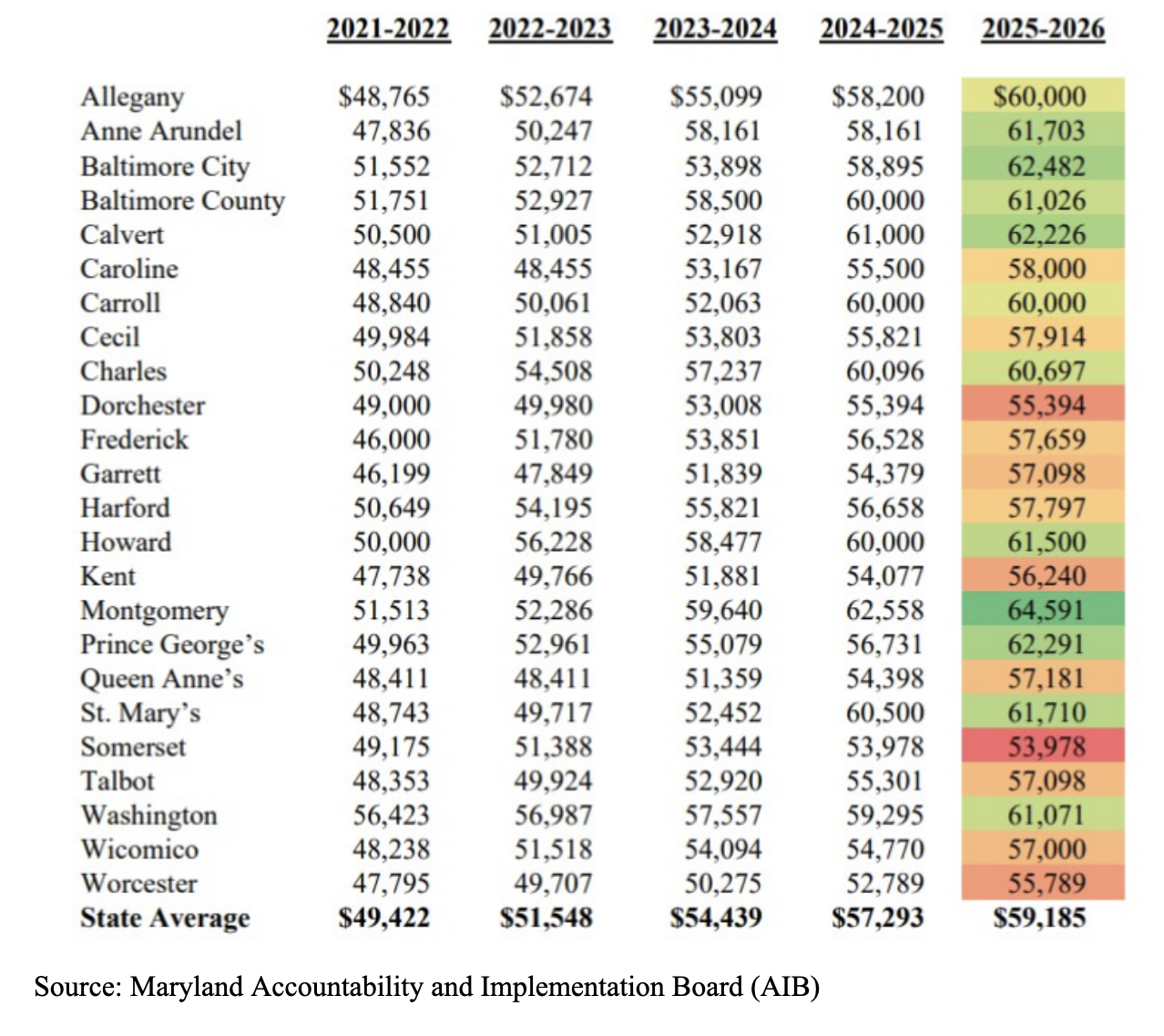
The chart is important because it shows both progress and unevenness. Some districts are closer to the target than others. Some have already moved aggressively. Others face steeper financial or structural challenges. But the equity question remains clear: if we believe every child deserves a well-prepared teacher, we must also believe every teacher deserves a professional wage.
The Public School Superintendents’ Association of Maryland has also offered recommendations based on the experiences of district leaders doing the daily work of implementation. Their recommendations include prioritizing Tier I four-year-old programs, reconsidering local education agencies’ responsibility for private pre-K providers, providing start-up funding for pre-K programs before EXCELS ratings are received, removing assistant principals and principals from career ladder requirements, pausing the 40% in-school planning requirement, allowing more flexibility in career counseling partnerships, revising funding for special education services, and extending funding for Targeted Support and Improvement schools, especially as related to Science of Reading implementation.
These recommendations reflect the reality that implementation must be informed by the people closest to the work. That does not mean weakening the Blueprint’s vision. It means strengthening the path to achieving it.
In recent editions of the Equity Exchange, we have focused on teacher job satisfaction, stress, workload, recruitment, retention, and shortages. The connections to the Blueprint are clear. In a Pew Research Center survey, 51% of teachers reported being “not at all” satisfied with how much they are paid. Compensation matters, but it is not the only issue. The same survey found that 84% of teachers said there is “not enough time in the day” to complete all their work.
The Blueprint attempts to address both.
Pillar 2 focuses on compensation, career pathways, National Board incentives, teacher preparation, induction, mentoring, and leadership. It also envisions a shift from teaching as an isolated activity to teaching as a more collaborative profession. Instead of spending most non-classroom time preparing lessons alone, teachers would have more time to work together, analyze student performance, coordinate instruction, identify struggling students earlier, and plan targeted interventions.
We know that teaching has become too complex to do well in isolation. The best teachers I have known were always learning, always refining, always looking at student work, and always asking what else they could do to help a child succeed. They deserved time to do that work well.
The Blueprint also includes initiatives that directly support students, including school readiness, early childhood education, and college and career readiness. The Early Childhood Education pillar expands access to affordable full-day pre-K, strengthens family support services, improves program quality, and expands wraparound supports. The College and Career Readiness pillar creates a new CCR standard, builds advanced pathways, aligns Career and Technical Education with workforce needs, and connects PK-12 curriculum and assessments to CCR goals.
Pillar 4 is also especially important for NCEED. By expanding community schools and targeted supports, the Blueprint acknowledges that educational disparities are tied to broader conditions affecting children and families. Community schools can provide mental health care, tutoring, family support, health services, and after-school programs that address barriers to learning in high-poverty communities.
At NCEED, our faculty and staff are already positioned to support the Blueprint across several areas, including special education, teacher preparation and development, literacy, early childhood education, social and emotional learning, family engagement, college readiness, and community-based research. This is where our work can be especially useful to Maryland.
We can help ask the right questions.
We can help examine whether implementation is reaching the children and communities most affected by disparities.
We can help identify what is working, where gaps remain, and how state and local partners can improve practice.
We can help connect research, policy, and the lived experiences of educators, families, and students.
This is why Dr. Kirwan’s engagement with NCEED has us so inspired. The Blueprint was built from a belief that Maryland can create one of the best education systems in the world. NCEED was built from a belief that educational disparities can and must be eliminated. Those two commitments belong in conversation with one another.
The Blueprint is not perfect. No reform this large ever is. It will require adjustment, discipline, transparency, resources, and continued public will. But its central promise is one we should not lose: Maryland’s children deserve better, and the state has a responsibility to build the systems that make better possible.
This month’s Numbers That Matter article takes a closer look at Pillar 1 of the Blueprint, Early Childhood Education, including full-day pre-K initiatives, wraparound services, and the overall quality of early childhood programs. Dr. Tajma Cameron’s article, Using Evidence-Based Practice to Make Summer Professional Learning Matter, examines the qualities of effective professional development and connects directly to the Blueprint’s focus on teacher growth and instructional improvement.
As I think back to my first classroom in Selma, I know that the promise of education reform ultimately comes down to what children experience every day. Do they have excellent teachers? Do they have strong early learning? Do they have access to rigorous coursework and meaningful career pathways? Do their families have support? Do their schools have the resources to meet their needs?
The Blueprint asks Maryland to answer yes.
At NCEED, our work is to help make that yes real.
– Meria J. Carstarphen
———————————————
References:
Accountability and Implementation Board. (2025, January 10). Item II. Teacher collaborative time. https://aib.maryland.gov
Asbury, N., 2025. Calls to adjust Maryland “Blueprint” for schools grow amid budget concerns. The Washington Post
Bruno, M., 2024. K-12 Teachers Are Not A Happy Lot. https://www.forbes.com/sites/brunomanno/2024/06/11/k-12-teachers-are-not-a-happy-lot/
Cormier, C., Wong, V., McGrew, J., Ruble, L., and Worrell, F., 2021. Stress, Burnout, and Mental Health Among Teachers of Color.”Learning Professional 42, no. 1: 54–57.
Darling-Hammond, L., Sutcher, L., & Carver-Thomas, D. (2016). Solving the Teacher Shortage: How to Attract and Retain Excellent Educators. Palo Alto, CA: Learning Policy Institute.
Doan, S., Steiner, E., & Pandey, R. Teacher Well-Being and Intentions to Leave in 2024 (RAND).
https://www.rand.org/content/dam/rand/pubs/research_reports/RRA1100/RRA1108-12/RAND_RRA1108-12.pdf
Forbes (Green, P.) 2024. The State Of The Teaching Profession. Forbes.com. https://www.forbes.com/sites/petergreene/2024/04/05/the-state-of-the-teaching-profession/
Ford, W. J. (2025, April 8). ‘Blueprint’ gets a trim after session that threatened major cuts: Multiyear education reform plan will see some programs, funding delayed. Maryland Matters. https://marylandmatters.org/
Ford, W. J. (2026, March 10). Half of Maryland’s school districts still not at $60K teacher salary threshold: They have until July 1 to meet state deadline, or possibly face withholding of state funds. Maryland Matters. https://marylandmatters.org/2026/03/10/half-of-marylands-school-districts-still-not-at-60k-teacher-salary-threshold/
García, E. & Weiss, E., 2019b. U.S. Schools Struggle to Hire and Retain Teachers: The Second Report in “The Perfect Storm in the Teacher Labor Market” Series. Economic Policy Institute.
García, Emma, and Elaine Weiss. 2019d. Challenging Working Environments (“School Climates”), Especially in High-Poverty Schools, Play a Role in the Teacher Shortage: The Fourth Report in “The Perfect Storm in the Teacher Labor Market” Series. Economic Policy Institute, May 2019.
Maryland State Department of Education. (n.d.). About us: Blueprint for Maryland’s Future. Blueprint for Maryland’s Future. https://blueprint.marylandpublicschools.org/about
Pew Research Center, 2024b. Lin, L., Parker, K., & Horowitz, J. M. (2024). 2023 Survey of US Teachers: Job Satisfaction and Outlook.
Pew Research Center, 2024c. What’s It Like To Be a Teacher in America Today? https://www.pewresearch.org/social-trends/2024/04/04/whats-it-like-to-be-a-teacher-in-america-today/
Pew Research Center, 2024. How K-12 public teachers manage their workload | Pew Research Center
Public School Superintendents’ Association of Maryland. (2024, December 11). PSSAM legislative and policy recommendations for the Blueprint for Maryland’s Future.
RAND Corporation, 2021. Melissa Kay Diliberti, Heather L. Schwartz, and David Grant, “Stress Topped the Reasons Why Public School Teachers Quit, Even Before COVID-19,”
Steiner, E. & Woo, A., 2021. Job-Related Stress Threatens the Teacher Supply: Key Findings from the 2021 State of the U.S. Teacher Survey. RAND Corporation.