


According to folklore, the proverb “This too will pass” was inscribed in a ring given to a Persian king by his wise men. In schools, change is so common the same proverb might just as well be inscribed on all the blackboards. Teachers often refer to the seemingly constant reforms and changes as the Flavor of the Month.
In the 1960s, elementary and secondary teachers learned to teach “modern math.” In the 1970s, criticism of “modern math” grew, and teachers were required to implement “back-to-basics” math. In the 1980s, Maryland high school English teachers were asked to become writing teachers when the state began requiring students to pass writing tests for graduation. Whole-group instruction was the norm for many years; then differentiation became popular; then RTI was introduced; and now many schools have implemented a Multi-Tiered System of Supports (MTSS). In many schools today, teachers are being asked to learn new systems based on the Science of Reading after years of being told that the Balanced Literacy approach was most effective.
Along with the frequent changes come debates about the efficacy and appropriateness of programs and practices such as phonics, language immersion, homework, summer school, differentiation, invented spelling, round-robin reading, pullout programs, small schools, small classes, prekindergarten, technology, and dozens of other organizational, instructional, curricular, and programmatic alternatives.
Perhaps the most challenging transition I have witnessed was when district leaders decided to expand principals’ autonomy. The theory of action was that schools would be more effective if principals had autonomy (i.e., greater responsibility) over their schools’ budgets, programs, curriculum, instruction, staffing, scheduling, and partnerships. Regardless of the approach’s efficacy, even advocates had little doubt that implementing and managing the transition would be extremely difficult.
This example highlights why change is so challenging. Change requires coordinated action across many people. It often takes sustained effort over time, and people may lack the training, skills, or resources to mitigate the challenges. In addition, people often become comfortable with familiar practices and resist changes that threaten their roles or authority. When changes happen routinely, organizations may develop cultures in which problems are normalized and inconvenient data are ignored. And, of course, change often requires acknowledging that previous decisions were ineffective.
One of the most glaring examples of resistance to change I witnessed was teachers in several schools literally hiding their old books to keep using them instead of adopting the new series. The experiences of the late Richard DuFour and his colleagues in implementing Professional Learning Communities (PLCs) are instructive about subtler challenges to change. DuFour believed that sustainable school improvement depends on teachers working collaboratively and taking collective responsibility for student learning. “In a PLC, the structure of the school is aligned to ensure teams are provided the time and support essential to adult learning” (Solution Tree, n.d.). However, becoming a viable PLC is a complex evolutionary process that does not happen by attending a conference, adopting a framework, and attending weekly meetings. There is no such thing as PLC time… A PLC is not an innovation. A PLC is a culture change that will take years and create conflict as well as success. It is hard work that depends on strong leadership” (Kohn, 2020).
DuFour offers several examples of PLCs that failed to achieve significant academic or instructional results. In one particularly illuminating case involving a low-achieving school, he describes a PLC in which the principal was proud of the collaborative work his teachers had done over two years. However, closer examination revealed that none of the decisions and changes the teachers agreed upon altered classroom practices. The PLC modified lunch, bus, and recess duties; agreed on homework, computer lab, and grading policies; planned holiday celebration activities; and changed other policies and practices. Yet none of the changes involved classroom instruction. As DuFour et al. (2006) noted, “In many schools, staff members are willing to collaborate on a variety of topics – as long as the focus of the conversation stops at their classroom door.”
Fidelity of Implementation (FOI) is the extent to which a program is implemented according to its original design or as intended. Unfortunately, many evaluation studies do not collect data on FOI, and there is “no universally accepted set of methods and procedures used as a standard in the study of FOI” (Ruiz-Primo, 2006). Furthermore, research also shows that even when data are available, most school leaders use evidence in a “superficial manner, leading to weak interpretation and limited understanding of underlying problems and available solutions” (Finnigan, 2013).
Concerns-Based Adoption Model (CBAM)
In the 1970s and 1980s, Gene Hall, Shirley Hord, and others introduced new approaches to studying organizational change in schools. In 1987, Hall and Hord published Change in Schools: Facilitating the Process. Since then, their CBAM model has been refined and expanded. However, the three core components remain the same:
- An Innovation Configuration map provides a clear picture of what constitutes high-quality implementation. It serves as an exemplar to guide and focus staff efforts.
- The Stages of Concern process… enables leaders to identify staff members’ attitudes and beliefs toward a new program or initiative. With this knowledge, leaders can take actions to address individuals’ specific concerns.
- The Levels of Use tool helps determine how well staff, individually and collectively, are using a program. Levels range from nonuse to advanced use. (ASCN, 2021),
CBAM focuses on the educator: What is the teacher doing, what are the teacher’s concerns, and what does implementation look like? The central idea is that successful change depends not only on introducing an innovation but also on understanding how people respond to and use it.
School Development Program (SDP)
In 1968, Child psychiatrist James P. Comer and colleagues at the Yale Child Study Center created the Comer School Development Program (SDP). The central idea was that children’s development and academic learning are inseparable. The Comer model extends beyond the classroom and includes nine essential elements. They are organized into three structures/mechanisms, three operations, and three guiding principles (Yale Child Study Center, n.d.; Comer, J. P., 1993; Lunenburg, F. C., 2011):
Structures
- School Planning and Management
- Student and Staff Support
- Parents
Operations
- Comprehensive School Plan
- Staff Development
- Assessment and Modification
Guiding principles
- No-fault problem solving
- Consensus decision-making
- Collaboration
Comer wasn’t proposing nine separate improvement programs. The elements were intended to work together as a schoolwide process for changing how the school is organized and how adults work together. The “Comer Process” is often closely associated with school climate, as it is designed to foster positive relationships among students, teachers, administrators, parents, and support personnel while addressing both students’ development and academic learning (Learning Policy Institute, 2021). Others have also provided compelling examinations of the psychology, history, and politics (internal and external) of school culture – its regularities, values, practices, and people – and its impact on school change (Sarason, 1996; Wasley et al., 1997).
Implementation Science
Today, implementation science continues to broaden the lens and, importantly, provides a detailed research framework. It examines the factors and mechanisms that explain whether a reform succeeds, fails, adapts, or becomes sustainable, including organizational readiness, leadership, resources, policy, context, implementation strategies, fidelity, adaptation, sustainability, implementation outcomes, and individual behavior.
In implementation science, researchers have used several terms to describe the factors that influence whether a new practice is successfully adopted and maintained (Damschroder et al., 2015; Proctor, 2011; Powell et al., 2015; Reardon et al., 2025). These include:
- Organizational readiness: Whether an organization is prepared and motivated to implement the change, including its capacity, commitment, and willingness to change. It also assesses whether staff understand the need for change, believe the organization can accomplish it, and are willing to invest the required time and effort.
- Leadership: The role leaders play in creating the conditions for implementation, including direction, support, resources, encouragement, and accountability for implementation. Effective leaders communicate a clear vision, set priorities, provide resources, remove obstacles, support staff, monitor progress, and reinforce the importance of the new practice.
- Resources: The people, time, money, staffing, knowledge, training, technology, materials, infrastructure, and other supports needed to implement the practice successfully. A promising program can fail simply because staff members lack adequate time for training, coaching, planning, or implementation.
- Policy: Laws, regulations, standards, funding requirements, and organizational policies that encourage, constrain, or shape implementation.
- Context: The broader conditions or environment in which implementation occurs, including organizational culture, community characteristics, competing priorities, and external conditions, staff relationships, student or community characteristics, political conditions, and other circumstances that can either facilitate or impede change.
- Implementation strategies: The specific actions that help people and organizations adopt and use a new practice effectively. Examples include professional development, coaching, technical assistance, implementation teams, feedback, data use, and ongoing monitoring. Strategies are essentially the “how” of implementation.
- Fidelity: The degree to which a practice is implemented as intended, particularly whether its essential components are delivered as intended. Fidelity does not necessarily require rigid adherence to every detail; rather, it asks whether the elements responsible for the practice’s effectiveness are preserved.
- Adaptation: Deliberately tailoring a program or practice to fit a particular setting or population – i.e., the local context – while maintaining the core features that make it effective. For example, a school might adapt a reading intervention’s literary content, scheduling, or training to fit its students and teachers without changing the intervention’s core instructional methods. The key question is: “How can we make this work here without losing what makes it effective?”
- Sustainability: The ability of an organization to continue implementing a practice and achieving its intended benefits over time, including after the initial implementation effort, funding, training, or outside support has ended. Sustainable implementation requires the practice to become part of normal organizational routines rather than depending indefinitely on a special grant, outside consultant, or particularly enthusiastic individual.
- Implementation outcomes: The results of the implementation process itself, rather than simply whether the program produced its desired student or client outcomes. Common outcomes include whether the practice was acceptable, adopted, appropriate, feasible, implemented with fidelity, affordable, reached the intended population, and sustained over time.
- Individual behavior: What individual practitioners do in response to the change, including what they know, believe, and decide. This includes whether teachers, clinicians, administrators, or other practitioners understand the innovation, believe it is worthwhile, acquire the necessary skills, begin using it, and eventually incorporate it into their routine practice.
Individual behavior occurs within an organizational context shaped by leadership, resources, policy, and readiness. Implementation strategies attempt to influence these factors and individual behavior. Fidelity, adaptation, and sustainability describe how implementation develops over time, and implementation outcomes indicate whether the process is succeeding.
One common approach to implementation science research uses the Consolidated Framework for Implementation Research (CFIR). The CFIR includes 48 constructs and 19 subconstructs across 5 domains:
- Innovation – the ‘thing’ being implemented, e.g., a new clinical treatment, educational program, or city service.
- Outer Setting – the setting in which the Inner Setting exists (e.g., hospital system, school district, state). There may be multiple Outer Settings and/or multiple levels within the Outer Setting (e.g., community, system, state).
- Inner Setting – the setting in which the innovation is implemented (e.g., hospital, school, city). There may be multiple Inner Settings and/or multiple levels within the Inner Setting (e.g., unit, classroom, team).
- Individuals’ Roles and Characteristics – the roles and characteristics of individuals involved in implementing the innovation.
- Implementation Process – the activities and strategies used to implement the innovation (see CFIR Constructs).
“The five steps below guide users through an entire project using CFIR, from the design of the study through dissemination of findings” (Reardon et al., 2025).
- Study Design. The first step is to determine what you want to understand and what implementation outcome you want to explain or predict. Researchers define the research question, identify the innovation being implemented, determine the relevant implementation setting, and decide which CFIR domains and constructs are relevant. CFIR can be used prospectively to identify factors likely to affect implementation or retrospectively to explain why implementation succeeded or struggled.
- Data Collection. Researchers then gather information about the barriers and facilitators affecting implementation. This might include interviews, focus groups, observations, surveys, documents, administrative data, or other sources. Researchers collect data from people involved in implementation and from the organizational and external settings in which implementation occurs. The goal is to understand what helps or hinders implementation from multiple perspectives.
- Data Analysis. The collected information is systematically analyzed using the CFIR constructs as an organizing framework. Researchers identify evidence related to particular determinants—for example, leadership engagement, available resources, organizational culture, individual knowledge and beliefs, or the quality of the implementation process. They then examine which factors appear to be associated with better or worse implementation outcomes.
- Data Interpretation. Researchers move beyond simply identifying barriers and facilitators to determining which factors matter and why. They assess the strength and direction of the evidence and identify the factors that appear to distinguish successful from unsuccessful implementation. These findings can then inform potential implementation strategies—for example, additional training, coaching, leadership support, resource changes, or modifications to the implementation process.
- Knowledge Dissemination. Finally, researchers communicate what they learned so that findings can inform practice, policy, future implementation efforts, and additional research. Dissemination is not simply reporting results; it involves making findings understandable and useful to the people who can apply them. The ultimate purpose is to build knowledge about what influences implementation, under what circumstances, and how to improve implementation (Reardon et al., 2025).
These are research steps, not five implementation stages. CFIR is a framework for identifying and explaining barriers and facilitators that influence implementation success (Reardon et al., 2025). The full model is available at the Consolidated Framework for Implementation Research. Finally, implementation is not successful unless it is equitable. Ensuring equitable implementation success requires equity-focused implementation process models and measurement frameworks (see Gustafson et al., 2023; Bradley et al., 2024; Allen, 2021).
Although CFIR includes an Implementation Process Domain, it captures the use and quality of these processes as determinants of implementation success, not as a direct guide to implementation. CFIR can inform the assessment of potential barriers and facilitators to implementation, but the authors recommend selecting a process model to guide implementation. Recommended process models include the Quality Implementation Framework (Meyers, 2012); Getting to Outcomes (Chinman, 2012); and Getting to Implementation (Rogal, 2020).
The central message is that implementation quality depends on deliberate preparation, ongoing support, monitoring, and continuous improvement—not merely selecting a program with evidence of effectiveness. In that sense, implementation science is not unlike Hall and Hord’s CBAM approach.
Similarly, implementation process models are not unlike the logic model concept many educational researchers know. However, they are not the same. The figure below compares process and logic models.
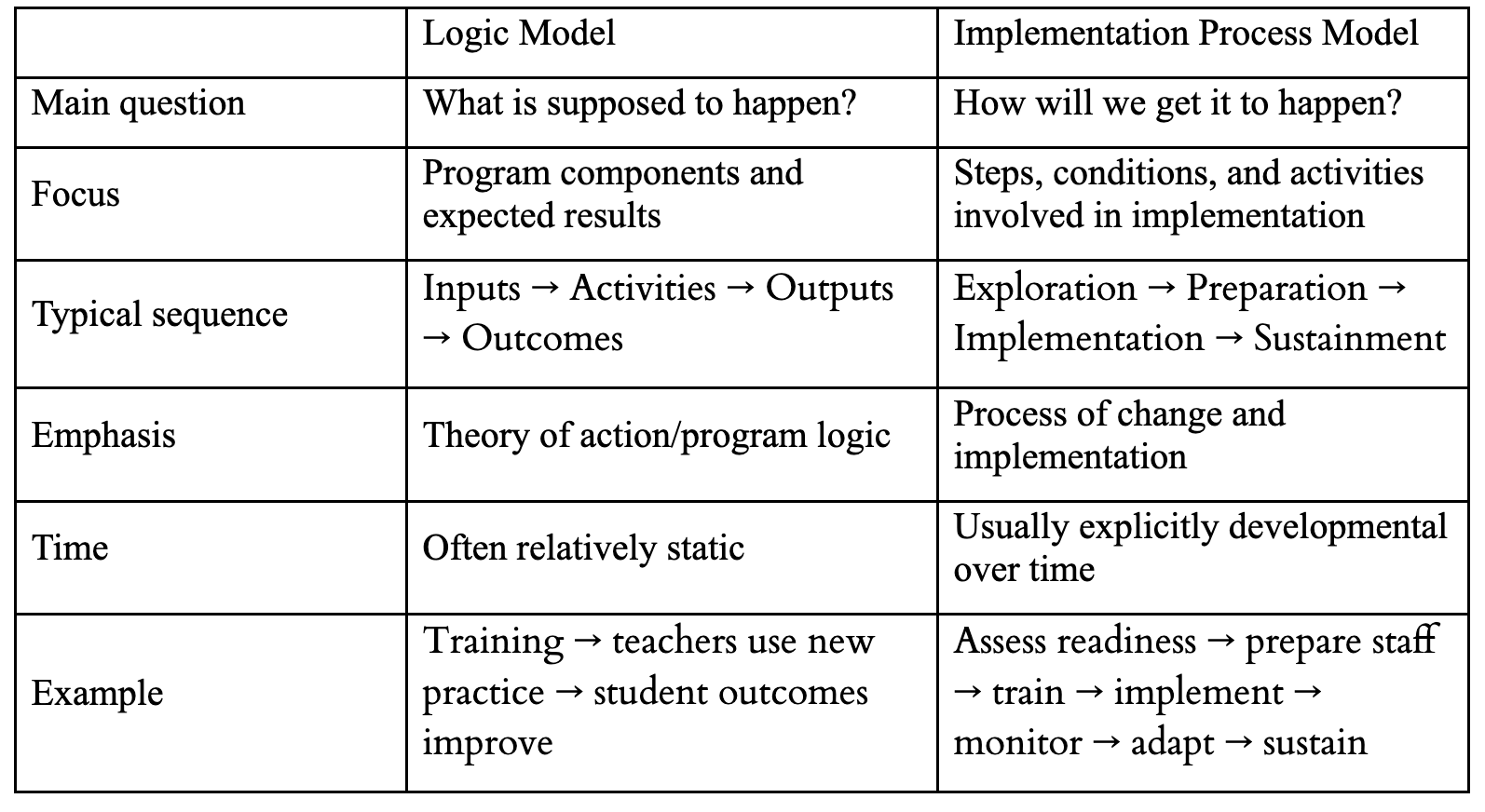
Logic models describe the program, while implementation process models describe how the program gets put into practice. Logic models describe what we expect the intervention to accomplish. Implementation process models describe how we will move from adoption to effective, sustained implementation.
Summary
Approaches like CBAM focus on the educator: What is the teacher doing, what are the teacher’s concerns, and what does implementation actually look like? CBAM recognizes that a central factor in successful change is understanding how people respond to and use it. However, as Nilsen (2020) notes, without a theoretical foundation, it is difficult to understand and explain how and why an implementation succeeds or fails.
Implementation science offers a broader, more detailed approach. It examines organizational readiness, leadership, resources, policy, context, implementation strategies, fidelity, adaptation, sustainability, implementation outcomes, and individual behavior. The Consolidated Framework for Implementation Research (CFIR) outlines five steps: Study Design, Data Collection, Data Analysis, Data Interpretation, and Knowledge Dissemination. CFIR can be used prospectively to identify factors likely to affect implementation or retrospectively to explain why implementation succeeded or struggled. CFIR can inform the assessment of potential barriers and facilitators to implementation; however, to guide implementation, Reardon et al. (2025) recommend using process models such as the Quality Implementation Framework (Meyers, 2012).
As noted in this edition’s Director’s Desk article, School Transformation: Ongoing Innovation and Progress, most public school leaders are almost obsessively focused on self-improvement. Yet student achievement and achievement gaps among student groups persist. Finnigan (2013) argues that a major reason for this lack of progress, despite schools’ efforts, is the “superficial manner” in which school leaders use information. Implementation science is designed to address this and other weaknesses. At NCEED, our focus is on solutions. As we begin another school year, our team will explore implementation science as a possible focus area, particularly equity-focused implementation process models and measurement frameworks.
References:
(The) Accelerating Systemic Change Network, 2021. https://ascnhighered.org/ASCN/change_theories/collection/cbam.html
Comer, J. P. (1993). James P. Comer, MD, on the School Development Program: Making a Difference for Children.
Comer, J. P., & Haynes, N. M. (1999). The Dynamics of School Change: Response to the Article, “Comer’s School Development Program in Prince George’s County, Maryland: A Theory-Based Evaluation,” by Thomas D. Cook et al. American Educational Research Journal, 36(3), 543-597.
Damschroder, L., Hall, C., Gillon, L., Reardon, C., Kelley, C., Sparks, J., & Lowery, J. (2015). The Consolidated Framework for Implementation Research (CFIR): progress to date, tools and resources, and plans for the future. Implementation science, 10(Suppl 1), A12.
Dearing, J. & Kerk, F. (2012). “Historical Roots of Dissemination and Implementation Science.” In Dissemination and Implementation Research in Health: Translating Science to Practice, edited by Brownson, R., Colditz, G., and Proctor, E. Oxford University Press. http://www.oxfordscholarship.com/view/10.1093/acprof:oso/9780199751877.001.0001/acprof-9780199751877.
Finnigan, K., Daly, A., & Che, J. (2013). Systemwide Reform in Districts Under Pressure: The Role of Social Networks in Defining, Acquiring, and Diffusing Research Evidence. Journal of Educational Administration. ISSN: 0957-8234
Hall, G., Wallace, R., & Dossett, W. (1973). A developmental conceptualization of the adoption process within educational institutions
Hall, G., George, A., & Rutherford, W. (1977/1979/1986). Measuring Stages of Concern About the Innovation: A Manual for Use of the SoC Questionnaire
Hall, G., & Hord, S. (1987). Change in Schools: Facilitating the Process.
Hord, S., Rutherford, W., Huling-Austin, L., & Hall, G. (1987). Taking Charge of Change.
Kohn, L. (2020). School of Thought Blog, Comment on: Four Strategies to Implement Effective PLCs, NASSP, https://www.nassp.org/2020/09/29/four-strategies-to-implement-effective-plcs/
Learning by Doing: A Handbook for Professional Learning Communities at Work, Richard DuFour, Rebecca DuFour, Robert E. Eaker, and Thomas Many, July 1, 2006, Solution Tree.
Nilsen, P. (2020). Making sense of implementation theories, models, and frameworks. In Implementation Science 3.0 (pp. 53–79). Springer International Publishing.
Learning Policy Institute. (2021). With the whole child in mind: Insights from the Comer School Development Program. Learning Policy Institute report
Lunenburg, F. C. (2011). The Comer School Development Program: Improving Education for Low-Income Students. In National Forum of Multicultural Issues Journal (Vol. 9, No. 1).
Nilsen, P. (2020). Making sense of implementation theories, models, and frameworks. In Implementation Science 3.0 (pp. 53–79). Springer International Publishing.
Nilsen, P., & Bernhardsson, S. (2022). Context matters in implementation science: A scoping review of determinant frameworks that describe contextual determinants for implementation outcomes. Frontiers in Health Services, 2, 905909. https://doi.org/10.3389/frhs.2022.905909
Powell, B. J., Waltz, T. J., Chinman, M. J., Damschroder, L. J., Smith, J. L., Matthieu, M. M.,
Proctor, E. K., & Kirchner, J. E. (2015). A refined compilation of implementation strategies: Results from the Expert Recommendations for Implementing Change (ERIC) project. Implementation Science, 10, 21. https://doi.org/10.1186/s13012-015-0209-1
Proctor, E., Silmere, H., Raghavan, R., Hovmand, P., Aarons, G., Bunger, A., Griffey, R., & Hensley, M. (2011). Outcomes for implementation research: Conceptual distinctions, measurement challenges, and research agenda. Administration and Policy in Mental Health and Mental Health Services Research, 38(2), 65–76. https://doi.org/10.1007/s10488-010-0319-7
Reardon, C., Damschroder, L., Ashcraft, L., Kerins, C., Bachrach, R., Nevedal, A., Domlyn, A., Dodge, J., Chinman, M., & Rogal, S. (2025). The Consolidated Framework for Implementation Research (CFIR) User Guide: A five-step guide for conducting implementation research using the framework. Implementation Science, 20(1), 39. https://doi.org/10.1186/s13012-025-01450-7
Ruiz-Primo, M. A. (2006). A Multi-Method and Multi-Source Approach for Studying Fidelity of Implementation. CSE Report 677. National Center for Research on Evaluation, Standards, and Student Testing (CRESST).
Rogal, S. S., Yakovchenko, V., Morgan, T., Bajaj, J. S., Gonzalez, R., Park, A., … & Chinman, M. J. (2020). Getting to implementation: a protocol for a Hybrid III stepped wedge cluster randomized evaluation of using data-driven implementation strategies to improve cirrhosis care for Veterans. Implementation Science, 15(1), 92.
Sarason, S. B. (1996). Revisiting: The culture of the school and the problem of change. Teachers College Press.
Solution Tree, adapted from the work of Richard DuFour, Rebecca DuFour, and Robert Eaker, A Big Picture Look at Professional Learning Communities, https://www.allthingsplc.info/files/uploads/brochure.pdf.
Wasley, P. A., Hampel, R. L., & Clark, R. C. (1997). Kids and school reform. Jossey-Bass.
Yale Child Study Center. (n.d.). Comer School Development Program. Yale School of Medicine. Yale Child Study Center — Comer School Development Program